

Leading a company always meant deciding who does the work. That question now has five parts, and only one of them is about people. What a person executes, what an agent executes, where the two meet, how much autonomy the agent receives, and who remains accountable for the outcome.
For decades, structures were designed around roles, capacity was tied to headcount, and processes assumed that at some point a person would execute, analyze, approve, or decide. An agent that receives an objective, consults information, uses systems, chains activities, evaluates intermediate conditions, and returns an outcome breaks that assumption quietly. The org chart does not change a line.
When this moves beyond individual experimentation into business processes, the organization begins distributing work between people and agents. That is the hybrid enterprise. Leading one requires decisions that introducing AI tools into the workplace never required.
What follows covers the six decisions this shift places on leadership. Redesigning work before automating it, calibrating how much autonomy each agent receives, growing governance at the same pace as that autonomy, preserving human accountability, managing a population of agents as infrastructure, and redefining what counts as productivity.
Counting agents describes inventory, not capability
Agent volume is not maturity. Hiring more people never guaranteed better execution, and adding agents to poorly designed processes automates waste, scales inconsistency, and accelerates the propagation of errors.
The debate is not settled by replacing people with artificial intelligence either. The International Labour Organization, in an analysis covering nearly 30,000 tasks at the six-digit occupational level, estimates that one in four workers worldwide is in an occupation with some degree of exposure to generative AI. The same analysis concludes that the continued need for human input makes occupational transformation more likely than full redundancy.
Work does not move in a single direction between people and AI
Anthropic's January 2026 Economic Index classified 52% of Claude.ai conversations as augmentation of human capability and 45% as automation, reversing the previous report. In the company's own API traffic, automation remained dominant. The methodology reflects usage patterns of Anthropic products and does not describe the entire labor market.
The most useful detail in that report for decision-makers sits elsewhere. Anthropic began measuring autonomy as a dimension separate from automation, and the example it uses resolves a common confusion. Translating a paragraph into French is highly automated and carries low autonomy, because the task requires little decision-making from the model.
The executive conclusion therefore fits neither "AI will replace people" nor "AI will only augment people." Different parts of work will be distributed differently between people and AI systems, and leadership decides how that distribution works.
The org chart stays correct and starts explaining less
Org charts answer well who leads the area, who owns the result, and who holds formal authority. They answer a different question increasingly poorly. How is that outcome actually produced?
Consider a finance function. One agent collects information from separate systems. Another identifies inconsistencies. A third prepares the initial variance analysis. A person interprets exceptions, adds business context, and decides which recommendation reaches the CFO. The org chart barely changed. The workflow changed entirely.
The same pattern appears in sales, technology, operations, and corporate functions. The unit of management analysis stops being only the role and starts including the workflow, a move high-performance technology teams already made by another route when they organized delivery around flow instead of function.
Redesign the work before delegating it to an agent
The most likely risk in this transition is placing agents on top of existing processes without challenging the process. Automation historically started that way, observing a human activity and trying to reproduce it with technology.
Agents open a more relevant possibility. Questioning the architecture of work. Why does this report exist? Why does this approval happen? Why does a given piece of information pass through four people? Why does one team produce a document that another manually converts into a different format? Why does a manager search five systems before deciding?
The opportunity is not executing each step faster. It is asking whether some of those steps still need to exist. The hybrid manager therefore takes on an additional role. Becoming, in part, an architect of work, able to decompose outcomes into activities and distinguish what depends on judgment, what depends on context, what requires relationships, what can be standardized, what can be automated, and where a person must remain in the process. That capability belongs to organizational design, not to prompt engineering.
Technical capability and organizational autonomy are separate decisions
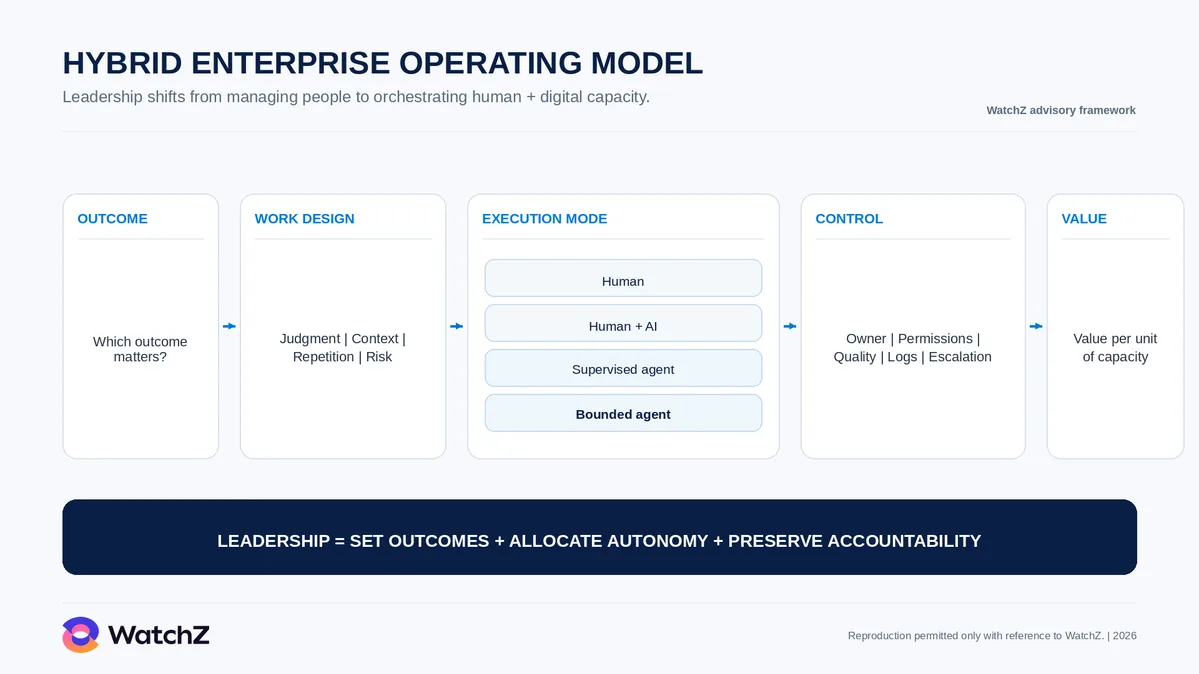
An agent capable of executing an activity should not automatically receive authority to execute it alone. A company can use agents to prepare financial decisions without authorizing payments, recommend infrastructure changes without applying them in production, or respond automatically to routine customer situations while requiring human approval for exceptions.
The question shifts from "can the agent do it?" to "what level of autonomy fits this context?"
Four levels of autonomy organize the decision
The model below is a WatchZ advisory construct for structuring management decisions, not a regulatory classification or a market standard.
Level 1, assistance. The agent researches, analyzes, organizes, or recommends. Execution and decision remain human.
Level 2, supervised execution. The agent produces the action or output. A person reviews or approves before it takes effect.
Level 3, bounded execution. The agent operates autonomously within predefined rules, permissions, and limits. People monitor indicators and handle exceptions.
Level 4, agentic operation. The agent executes a broader workflow inside a controlled domain. People define outcomes, policies, limits, metrics, and intervention mechanisms.
The level should be determined by the risk of the work, not only by the capability of the agent. An agent technically ready for level 4 operates at level 2 when error reversibility is low.
Autonomy should not grow faster than the ability to govern it
An asymmetry between people and agents changes the risk calculation. A person makes an error. An agent turns the same error into repeatable behavior. The greater the autonomy, execution frequency, and reach, the faster a poor decision propagates.
The principle appears explicitly in the EU AI Act for systems classified as high-risk. Article 14 requires effective human oversight and states that measures should be proportionate to risk, level of autonomy, and context of use. Applying high-risk legal obligations to every enterprise agent would be excessive. Extracting a management principle from them is precise, and the principle is that autonomy should not grow faster than the organization's ability to govern it. The same proportionality logic supports AI governance calibrated to the exposure of the use case.
Delegating to an agent means designing a control system
When a manager delegates an activity to an experienced person, a large amount of implicit knowledge travels with the delegation. Agents operate differently.
Delegating to them requires making explicit what organizations usually leave implicit. Objectives, accessible data, usable systems, authorized and prohibited actions, quality standards, exception criteria, stop conditions, escalation, logging, and responsibility for change. Agentic delegation is an architecture decision, and architecture in this context is as much governance as technology. It is the same ordering that makes autonomous agents generate returns only when identity, workflow, and governance come before the model.
Accountability stays human even when execution does not
Who answers when an agent takes the wrong action? Saying "the AI made a mistake" describes the event and does not resolve organizational responsibility.
The NIST AI Risk Management Framework emphasizes that trustworthy AI depends on accountability and transparency, and recommends considering the roles of different AI actors when assigning responsibility for outcomes. Every material agentic workflow should make it possible to answer clearly who owns the outcome, who owns the agent, who controls permissions, who evaluates performance, who can stop it, and who handles an exception.
When nobody can answer those questions, the organization does not have distributed autonomy. It has operational opacity.
Middle management gains a function instead of losing one
Much of the debate around agents assumes technology will reduce the need for middle management. In some contexts that happens. In others, the middle manager becomes central to the hybrid enterprise, because they know the work closely enough to understand exceptions and broadly enough to see the process.
The role stops being predominantly about distributing tasks and tracking execution. It starts including the design of the best combination of people, agents, rules, and outcomes. Transactional management loses ground. Managers who can architect work gain it.
The counterpart holds. The more execution technology absorbs, the higher the relative value of judgment, context, prioritization, negotiation, critical thinking, responsibility, communication, and the ability to frame the right problem. AI maturity does not mean delegating everything. It means knowing what not to delegate.
A population of agents becomes infrastructure and needs lifecycle management
With three experimental agents, governance looks secondary. With hundreds of them spread across processes, the situation changes in nature.
Who created each agent? Who owns it? Which data can it access? Which systems can it use? Which versions are active? Which policies apply? When was it last evaluated? What decisions did it execute? What does it cost to operate? Which other agents depend on it?
Past a certain point, agents stop being individual tools and become part of organizational infrastructure, with identity, permissions, observability, logs, security, evaluation, and lifecycle management. The operational question moves from "how do we create an agent?" to "how do we operate a growing population of agents without losing control?"
Productivity measured in hours stops describing hybrid work
If an analysis once consumed eight hours of professional work and now takes minutes to produce plus twenty minutes of human review, counting hours no longer describes productivity.
Measuring speed alone would be the next risk. The process can become faster while simultaneously producing more rework, increasing risk exposure, or creating additional supervision cost. Hybrid enterprises need to observe time to outcome, cost per outcome, quality, rework, exception rates, human interventions, failures, supervision cost, financial impact, and risk produced. The goal is not to maximize automation. It is to maximize value per unit of capacity within acceptable quality and risk boundaries, which calls for capability metrics rather than activity dashboards.
Technology adoption and organizational change move at different speeds
Leadership sees an agent as additional production capacity. A professional sees the same agent as a threat to the role. Both readings coexist, and no project communication resolves that.
Microsoft's 2026 Work Trend Index, fielded with 20,000 AI users across ten markets between February and April 2026, found that only 26% perceive their own leadership as clearly and consistently aligned on AI. The same study measured 29 factors associated with the real impact of AI and attributed 67% of the signal to organizational factors such as culture, manager support, and talent practices, against 32% for individual factors. The authors classify the relationship as associative rather than causal, and the data is self-reported from inside the vendor's own ecosystem.
The management reading that survives those caveats is direct. What separates companies extracting value from AI from those that do not sits more in the organizational environment than in the individual. Leaders need to explain why the change is happening, which activities change, what remains a human responsibility, which skills gain importance, how performance will be evaluated, and how people participate in redesigning processes.
Six capabilities define hybrid-enterprise maturity
The set below is a WatchZ advisory framework, built for diagnosis rather than certification.
Work architecture. The organization decomposes processes and deliberately decides what remains human, what is assisted, what is automated, and what is executed autonomously.
Autonomy management. Explicit criteria determine how much execution authority each agent receives, considering impact, reversibility, and risk.
Accountability. Human responsibility stays clear even when a significant share of execution is performed by AI systems.
Agentic infrastructure. Identity, data, integrations, permissions, security, observability, and lifecycle are managed systematically.
Continuous evaluation. The organization measures quality, cost, exceptions, failures, human intervention, and the economic impact of agents.
Human development. Professionals are prepared not only to use AI, but to delegate, review, challenge, supervise, and improve work performed alongside agents.
No capability creates maturity on its own. Their combination turns agents from individual tools into governed organizational capability.
Executive allocation gains a third variable
For a long time, two of the central executive decisions were allocating capital and allocating people. Agents add digital execution capacity as a third variable, and workforce planning starts including new questions. How many people do we need? Which human capabilities should we preserve or develop? Which work should be redesigned? Which agents participate? How much autonomy can they receive? What infrastructure is required? What does supervision cost? What risk is created? Who answers for the outcomes?
That discussion is larger than technology. It is organizational design, and it belongs in the same place where the technology operating model is decided. The company with the most agents will not be the most advanced. Advantage will come from another combination. The right people, the right agents, well-designed work, autonomy proportional to risk, explicit accountability, and governance strong enough to scale.
Conclusion
Artificial intelligence does not eliminate the need for human leadership. It expands its scope.
Leaders remain responsible for strategy, priorities, culture, people, and outcomes. They also become responsible for how digital capacity participates in execution, where the boundaries sit, how much autonomy each agent receives, the oversight mechanisms, the new definition of productivity, the protection of human capabilities, and the governance of a population of agents.
The strategic question is not how many agents your company will have, nor how many people AI can replace. It is whether your company knows how to lead a workforce whose execution capacity no longer depends exclusively on people. The managerial follow-up to that question sits in which decisions a manager makes before execution begins. Anyone who cannot yet answer can start with the inventory. Pick one material process, list where execution already stopped being human, mark the autonomy level at each point, and name who answers for it. A capability assessment draws that map across the rest of the operation and shows where granted autonomy has already outrun available governance.
Sources
- International Labour Organization. "Generative AI and jobs: A 2025 update". https://www.ilo.org/publications/generative-ai-and-jobs-2025-update
- International Labour Organization. "Generative AI and Jobs: A Refined Global Index of Occupational Exposure" (ILO Working Paper 140). https://www.ilo.org/publications/generative-ai-and-jobs-refined-global-index-occupational-exposure
- Anthropic. "Anthropic Economic Index report: Economic primitives" (January 2026, based on November 2025 data). https://www.anthropic.com/research/anthropic-economic-index-january-2026-report
- Microsoft WorkLab. "2026 Work Trend Index Annual Report: Agents, human agency, and the opportunity for every organization" (n = 20,000, ten markets, fielded 18 February to 20 April 2026). https://www.microsoft.com/en-us/worklab/work-trend-index/agents-human-agency-and-the-opportunity-for-every-organization
- European Union. "Regulation (EU) 2024/1689 - AI Act, Article 14, human oversight". https://eur-lex.europa.eu/eli/reg/2024/1689/oj/eng
- NIST. "Artificial Intelligence Risk Management Framework (AI RMF 1.0)". https://www.nist.gov/itl/ai-risk-management-framework
- WatchZ. "Hybrid enterprises require a new way to lead people and AI agents". Revised editorial version, September 2026.
Note: Microsoft and Anthropic data describe those companies' ecosystems and research and should not be read as universal market statistics. The four autonomy levels and the six maturity capabilities are WatchZ advisory constructs with no correspondence to a regulatory standard or third-party framework. This material offers strategic and organizational analysis, not legal, regulatory, or audit advice.