


Autonomous agents arrived on the executive agenda with a seductive promise. Execute tasks, take operational decisions and reduce friction without continuous human intervention. The promise is relevant. The question that separates experiment from scale is another one.
The right question is no longer whether the agent can answer, plan or call a tool. It is whether the company can place it inside real workflows, with its own identity, a bounded permission, continuous audit, human decision at the right point and a measured financial result. That is the divide between experiment and scale.
An autonomous agent operates as an actor inside the company. It accesses data, interprets context, calls systems, executes steps, triggers APIs, generates recommendations and, in some cases, changes the state of real processes. When that capability goes into production without operational architecture, it does not reduce complexity. It redistributes it.
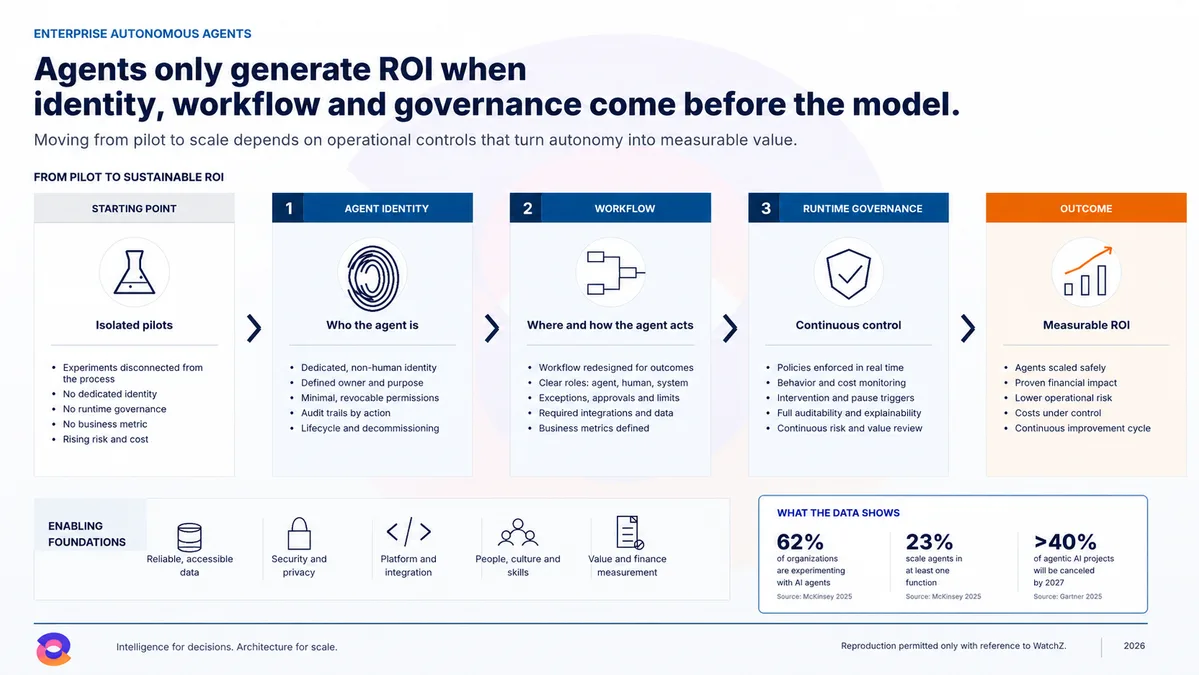
The market already shows the tension. A global survey of executives indicates that 23% of organizations scale some agentic AI system in at least one function, while 39% are still experimenting. The same survey finds that 39% attribute some EBIT impact to AI, almost always below 5% of EBIT. The executive reading is direct. Adoption is not scale, scale is not ROI, and ROI does not appear without operational design.
Buying an agent platform accelerates the start, it does not guarantee value
Buying a platform can accelerate the start. It does not replace design. Agents generate return when they enter redesigned workflows. Without that, they only automate the existing disorder with more speed.
The technology can be advanced and the process still fragile. The model can interpret well and the data be inconsistent. The tool can execute and the permission be too broad. The agent can look efficient and the financial impact stay invisible.
The evaluation tends to stop at the demo, without checking the ability to change operational performance under control. The discussion should not start with the model. It should start with the workflow. Five questions order the decision.
- Which operational constraint has to be removed?
- Which decision can be delegated?
- Which step has to stay human?
- Which risk cannot be automated?
- Which metric will prove there was a real gain?
Without those answers, the agent becomes a new layer over old problems.
Agent identity becomes critical infrastructure
The first blocker to scale shows up in a simple question. Who is this agent inside the company?
Without its own identity, the agent inherits human credentials, uses permissions that are too broad, leaves confusing trails and makes it hard to answer who authorized each action. That becomes an accountability problem. When something fails, it is not enough to know that the AI acted. The organization needs to know which agent acted, on whose behalf, with which permission, in which context, against which policy and with which evidence.
Agent identity means its own credential, a defined owner, a declared purpose, a bounded permission scope, per-action logs, privilege review, a documented lifecycle and a pause mechanism. Without that base, autonomy becomes a risk surface.
A security survey shows the size of the problem. 82% of organizations discovered shadow AI agents in the past year. Only 21% keep a formal decommissioning process for agents and just 19% report high confidence in fully retiring them. This is not a technical security detail. It is an enterprise architecture decision. An agent in production has to be treated as a governed operational identity.
The gain comes from the redesigned workflow
The real gain does not come from the agent. It comes from the work it changes.
When the company connects an agent to an old process, without redesigning inputs, exceptions, approvals, responsibilities, integrations and metrics, it accelerates the inefficiency. The agent multiplies the workflow that already existed.
- If the workflow is bad, the gain is apparent.
- If the data is fragile, the recommendation is unstable.
- If the exception is not mapped, the risk grows.
- If the metric does not exist, ROI turns into narrative.
That is why operational redesign comes before scale. The path starts by choosing a specific business workflow and defining the expected result. Then it separates what the agent can decide, what it can recommend, what it only prepares and what stays under human decision.
Autonomy should not be binary. Between forbidding and freeing there is progressive delegation. The company increases autonomy as confidence, evidence, control and operational maturity increase. That is how the agent stops being a technology experiment and becomes an enterprise capability.
Governance has to enter execution
Agent governance cannot depend on periodic review alone. The committee still matters, to set policy, risk appetite, responsibilities, prioritization criteria and autonomy limits. Operational control has to happen at the moment of action.
Agents call tools, access systems and execute steps at a speed incompatible with purely documentary governance. An agent generates cost, exposes data, contacts a customer, changes a record or takes an intermediate decision before a human review notices the deviation.
In execution, governance means policy-based authorization, per-task scope, behavior observability, decision logging, cost monitoring, input and output traceability, intervention triggers, autonomy limits and the ability to stop. Runtime governance is not bureaucracy. It is the mechanism that lets the company increase autonomy without losing control.
Companies that treat governance as a brake restrict adoption too much. Companies that ignore governance scale risk. The balance lies in turning artificial intelligence governance into operational infrastructure.
Projects without measurable value will be canceled
A market forecast estimates that more than 40% of agentic AI projects may be canceled by the end of 2027. The research behind the number points to rising cost, unclear business value and inadequate risk control as causes. The forecast is harsh and does not surprise.
Agent projects fail when they start with the tool, not the workflow. When they promise ROI with no baseline. When they go into production with no identity. When they depend on manual control for automated decisions. When cost grows and no one can demonstrate operational impact. The cancellation, in that case, is an operating-model failure, not an AI failure.
Leadership has to separate three layers the market mixes together. Automation executes tasks. Autonomy takes or chains decisions within limits. Result appears when that autonomy reduces cost, increases productivity, improves experience, lowers risk or accelerates revenue in a measurable way. Confusing the layers leads to fragile investment.
The executive path starts with the inventory
The company does not need a giant transformation program. It needs visibility, control and prioritization. Five steps order the advance.
- Build a living inventory of agents. Formal and informal. Each agent with an owner, a purpose, systems accessed, data used, credentials, permission scope, risk level and a stop mechanism.
- Classify the workflows. An agent that summarizes information carries a different risk from one that approves credit, changes an order, triggers customer communication, moves regulated data or touches a critical system.
- Redesign the workflow before scaling. The question is not where to put AI. It is which operational constraint blocks results and which part of it can be delegated safely.
- Define metrics before expanding. Cycle time, avoided cost, reduced error, volume handled, customer satisfaction, mitigated risk and financial impact.
- Build runtime governance. Policies, logs, continuous evaluation, audit trails, tests, cost monitoring, access limits, permission review and response plans.
Without that, the company does not have an agent strategy. It has distributed experimentation.
Architecture decides whether the agent becomes value or debt
Autonomous agents are not an isolated AI initiative. They depend on reliable data, integration, security, observability, identity management, platform architecture, process design, decision model and governance. That dependency changes the nature of the executive decision.
The decision does not stop at choosing the tool. It moves on to the organizational capability that has to mature for the agent to operate safely and generate value.
A company with fragile architecture stacks agents on fragile integrations, broad permissions, poorly defined processes and inconsistent data. The result looks like progress in the short term and turns into operational debt fast. A company with disciplined architecture starts with high-value workflows, bounds autonomy, controls identity, measures impact and scales only when the operating model supports it.
The strategic point is direct. Agents do not remove the need for architecture. They raise the cost of not having it.
Conclusion
The next cycle of enterprise AI will not be won by whoever buys the most advanced agent. It will be won by whoever turns agents into governed operational capability.
- Identity before autonomy.
- Workflow before model.
- Governance in execution before scale.
- Metric before the ROI talk.
An autonomous agent in production is a decision about architecture, operation and executive accountability, not just an AI project. The next layer of that decision is managerial, because leading hybrid teams of people and AI agents means calibrating autonomy to the risk of the work and naming who answers for each workflow. The company that understands this first captures value more safely. The one that ignores it will find out too late that autonomy without control does not scale results. It scales risk.
Sources
- McKinsey & Company. "The State of AI". Global survey on the state of AI in organizations. Available at: https://www.mckinsey.com/capabilities/quantumblack/our-insights/the-state-of-ai
- Cloud Security Alliance. "Autonomous but Not Controlled: AI Agent Incidents Now Common in Enterprises". Security survey on AI agent incidents. Available at: https://cloudsecurityalliance.org/artifacts/autonomous-but-not-controlled-ai-agent-incidents-now-common-in-enterprises
- Gartner. "Gartner Predicts Over 40% of Agentic AI Projects Will Be Canceled by End of 2027". Available at: https://www.gartner.com/en/newsroom/press-releases/2025-06-25-gartner-predicts-over-40-percent-of-agentic-ai-projects-will-be-canceled-by-end-of-2027