


For decades, managerial work was built on one simple constraint. Execution capacity was human. Someone had to break objectives into activities, distribute those activities across people, track deadlines, consolidate information, resolve dependencies and escalate problems.
AI agents are beginning to absorb part of that mechanics. They research, analyze, produce first drafts, query systems, chain activities and, within limits, make intermediate decisions to complete an objective.
This does not eliminate management. It lowers the value of one specific part of it, and that part carried most of the managerial routine.
This article covers the five decisions that now define the outcome before execution begins, and two mistakes that show up along the way. The manager who becomes an approval queue, and the organization that automates low-value work without noticing it was training people for the high-value kind. It is the second piece in the hybrid enterprise series and complements how to lead hybrid teams of people and AI agents, which covers how work is distributed. This one covers how that distribution is decided.
The role does not disappear, its composition changes
Discussions about AI and management usually end in a binary question. Will AI replace managers? That is the wrong question.
Manager is not an activity. It is a bundle of activities with different natures. Some exist to transmit information, others to resolve ambiguity. Some consist of tracking execution, others require understanding political, economic or human context.
AI does not need to absorb the whole role to change what it is worth. It only needs to absorb the activities that filled most of the calendar. Consolidating status, preparing analysis, producing first drafts of plans, distributing information, organizing activities, spotting deviations and preparing recommendations.
The likely result is not less management. It is a different kind of management, judged by a different standard.
Automating tasks and redesigning work are different operations
This is where the most expensive conceptual error lives. The organization looks at the current process, lists the tasks people perform and asks which one AI can take. That is automation. It can create value and it is not redesign.
Redesign starts earlier, and it starts with uncomfortable questions. Why does this process exist? What outcome should it produce? Which decisions actually need to happen? Which activities exist out of necessity and which exist only because the process was built that way? Where does a wait produce no value? Where does an approval protect the organization, and where does it only add latency?
Only after those questions does it make sense to decide whether the activity should be human, assisted, automated or executed by an agent.
Digitizing waste does not remove the waste. That does not make every automation applied to an imperfect process useless, because intermediate improvement creates value too. The risk is mistaking a local efficiency gain for a change in the system of work. Automating a bad step makes the bad step faster.
The correct order is outcome, work, capacity
Traditional management starts with the team. I have these people, how do I distribute the work? The reverse order produces better decisions. I need this outcome, which configuration of work achieves it, and only then, which capacity participates.
Capacity here no longer means only people. It means people, agents, traditional automation, software, platforms, vendors and data.
That inversion is what separates designing work from distributing tasks, and it unfolds into five decisions.
First decision: the outcome must be an outcome, not an activity
Bad work architecture starts by listing tasks. Good work architecture starts by naming outcomes. The distinction sounds semantic and it is not.
"Produce a report" is a task. "Let the CFO spot material deviations before the next capital decision" is an outcome. "Answer tickets" is an activity. "Resolve the customer need within the defined service and risk level" is an outcome. "Review code" is an activity. "Reduce the probability of an unsafe change reaching production" is an outcome.
When the organization defines work by task, it automates tasks. When it defines work by outcome, it can redesign the whole system. Translating strategic intent into operational outcomes clear enough for people and agents to work around becomes one of the manager's central deliverables.
Second decision: decompose the work by what it demands
A process is not a single unit. Different parts have different natures. Some require analysis, others relationships. Some are reversible, others are not. Some carry objective quality criteria, others depend on judgment. Some tolerate error, others carry financial, regulatory or reputational consequence.
The manager needs to see the work at that granularity to decide how each part should be executed. Not to micromanage. To decide.
Third decision: choose the execution mode
Once the work is understood, the decision a company will make thousands of times appears. Which combination of human and digital capacity performs this activity?
Human. The person executes because context, judgment, relationships or responsibility make delegation inappropriate.
Human with AI support. The person leads the work and uses AI to extend analysis, speed or reach.
Supervised agent. AI performs a meaningful share and a person reviews certain decisions or outputs.
Agent with bounded autonomy. The agent operates alone within defined rules, permissions and conditions, escalating exceptions.
These modes are not mandatory maturity stages. A process can stay deliberately human inside a technologically sophisticated company. Maturity is not maximizing autonomy. It is deciding consciously where autonomy creates value.
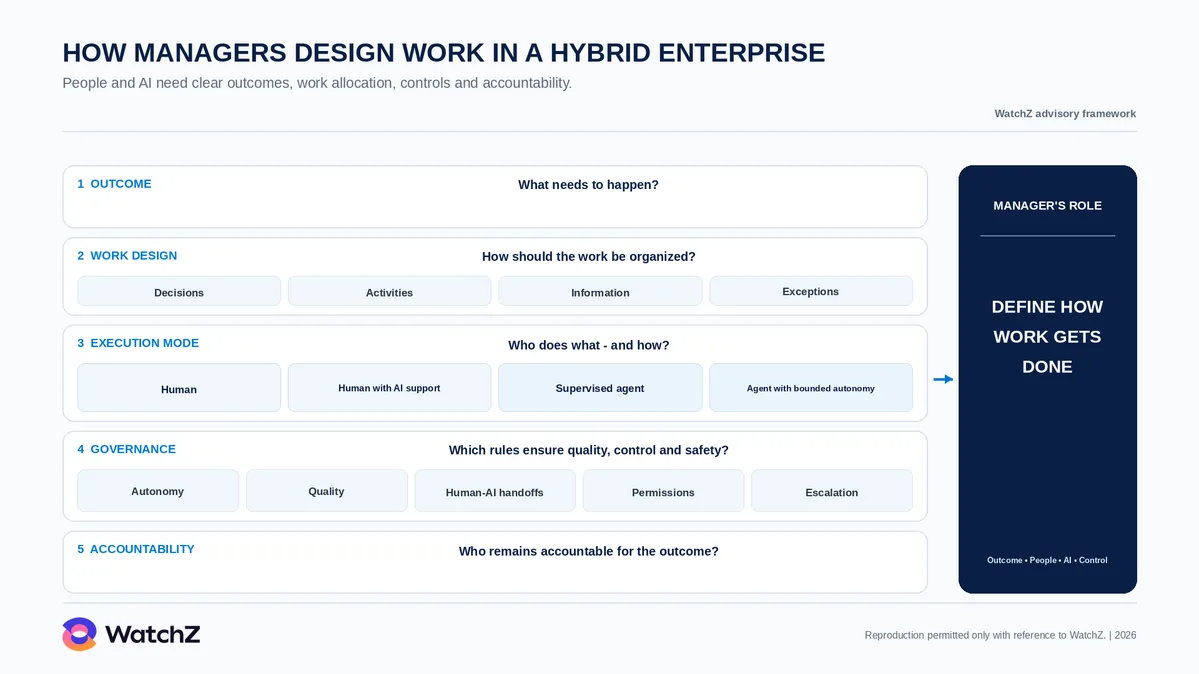
Fourth decision: autonomy does not follow capability
Delegating an activity and granting autonomy are separate decisions. An agent can produce an analysis without authorization to apply it. It can recommend a change without executing it. It can draft a reply without sending it. It can start a transaction below a threshold and escalate above it.
Anthropic began measuring autonomy as a dimension separate from automation precisely because a task can be highly automated and still require little decision-making from the system. In a study of roughly 400,000 Claude Code sessions across roughly 235,000 users between October 2025 and April 2026, the authors found a consistent split. People made approximately 70% of planning decisions, about what to build, while the model made approximately 80% of execution decisions, about how to build it. The authors describe the finding as preliminary, restricted to coding work and specific to the company's products, which rules out generalizing it across all business functions.
The implication for the manager is direct. The question stops being whether the agent can, and becomes how much decision power the organization is willing to delegate.
Fifth decision: the handoff between human and agent must be designed
The hardest part of a hybrid system sits neither in the human work nor in the agent's work. It sits at the boundary.
When does the agent hand off to a person? When does the person hand it back? What counts as an exception? What context travels with the handoff? Does the agent inform or recommend? Who decides whether the flow continues?
Without that design, hybrid systems produce fragmented responsibility. The person believes the agent is monitoring. The agent was configured assuming that decision belongs to the person. The process stops, or continues while nobody notices a decision was left open.
NIST, discussing human-AI interaction, recommends that human roles and responsibilities in decision-making and oversight be clearly defined, recognizing that configurations range from manual operation to autonomy. It is an artificial intelligence governance question and a management question. Someone has to define where responsibility crosses from one side to the other.
The manager who approves everything becomes the new bottleneck
There is a bad path through this transformation, and it is the most likely one. Agents execute more, output volume grows, managers start reviewing everything, and middle management turns into an approval queue.
That is not work redesign. It is bottleneck displacement.
If AI lowers the cost of producing and disproportionately raises the cost of reviewing, the organization increases output without increasing productivity. The gain shows up in the delivery count and disappears from the result.
The right question is not where to put a person in the loop. It is at which points human intervention creates value proportional to its own cost and to the risk it avoids. Some decisions require individual approval. Others can run by exception, by sampling or through a monitored indicator. Some activities should not be delegated at all.
Human oversight is a mechanism. On its own, it is not an operating model.
Automating low-value work can break the training path to high-value work
There is a risk of over-rationalization that barely appears in this discussion. Not all human work is only a set of optimizable tasks.
Some activities build capability. Others build trust. Some let professionals accumulate the tacit knowledge they will need to decide five years from now. Others sustain culture and relationships.
If the organization automates everything it classified as low value without understanding how people used to learn the high-value work, it solves this quarter's productivity and creates a capability-formation problem that only surfaces later.
Work architecture has to answer three questions at once. What are we automating, what are we preserving, and where will people develop the experience needed to take on greater responsibility tomorrow. That is a talent decision, not an automation decision.
Metrics and middle management shift alongside
Two consequences follow this change and were covered in detail in the article on leading people and AI agents.
The first is measurement. A task-centered model measures activity, and activity gets cheap when agents expand generation capacity. An agent can produce ten reports where there was one. If nobody decides better, productivity did not improve. Focus has to move from activity volume to time to outcome, cost per outcome, rework, exception rate and economic impact, supported by capability metrics.
The second is middle management. The manager who works as a transmission layer for information is exposed. The one who understands how the organization actually produces results gains ground. That does not guarantee current structures survive, and different companies will respond by removing layers, widening spans of control or recomposing responsibilities.
The problem is organizational before it is individual
Individual training does not solve this. A person learns to use AI and keeps operating inside processes, policies, incentives and metrics designed for a different reality.
Microsoft calls that misalignment the Transformation Paradox. People experiment with new ways of working while the management system keeps rewarding the old ones. In the 2026 Work Trend Index, fielded with 20,000 AI users across ten markets between February and April 2026, only 26% saw their own leadership as clearly and consistently aligned on AI. The same study found a stronger association between self-reported outcomes and organizational factors such as culture, manager support and talent practices than with individual factors, and the authors note that association does not demonstrate causality.
Letting people change how they work is not enough. The system that defines what the organization counts as good work has to change too.
The manager needs to understand systems, not write code
There is an equally mistaken reading on the other side. Imagining every manager will have to become an AI engineer.
What they need is enough systems thinking to understand dependencies, inputs, outputs, constraints, feedback loops, exceptions, risks and permissions. Not to implement, but to ask good questions about how the system behaves.
A manager who does not understand how the work happens will struggle to decide where AI should participate in it. And a manager who delegates that understanding entirely to the technology function is outsourcing a responsibility that belongs to them. The process belongs to the business, the technical architecture involves technology, and the work design is shared. It is the same boundary that defines a functioning technology operating model.
Conclusion
AI does not make management irrelevant. It makes some forms of management hard to justify.
The manager whose main value lies in receiving information, distributing tasks, tracking status and consolidating results will see a growing share of that function absorbed. This does not mean every managerial structure shrinks, nor that every manager migrates naturally. It means the standard of value changed.
Someone will still have to decide which outcome matters, which work needs to exist, what stays human, what can be delegated, how much autonomy is acceptable, where control is required, which exception escalates, how quality is measured and who answers for the result. Those nine questions are the new content of the role.
Start with one material process in your operation. Write down the outcome it should produce, not the tasks it performs. Mark where judgment lives, where repetition lives and where irreversible risk lives. Choose the execution mode for each part and name who answers for it. If the exercise does not fit on one page, the process is not yet understood, and a capability assessment shows where that clarity is missing across the rest of the operation.
The hybrid enterprise does not eliminate the manager. It raises the standard by which their contribution is judged.
Sources
- Anthropic. "Anthropic Economic Index report: Economic primitives" (January 2026, based on November 2025 data). https://www.anthropic.com/research/anthropic-economic-index-january-2026-report
- Anthropic. "Agentic coding and persistent returns to expertise" (roughly 400,000 sessions and 235,000 users, October 2025 to April 2026). https://www.anthropic.com/research/claude-code-expertise
- Microsoft WorkLab. "2026 Work Trend Index Annual Report: Agents, human agency, and the opportunity for every organization" (n = 20,000, ten markets, fielded 18 February to 20 April 2026). https://www.microsoft.com/en-us/worklab/work-trend-index/agents-human-agency-and-the-opportunity-for-every-organization
- NIST. "Artificial Intelligence Risk Management Framework (AI RMF 1.0)". https://www.nist.gov/itl/ai-risk-management-framework
- NIST AI Resource Center. "Appendix C: AI Risk Management and Human-AI Interaction". https://airc.nist.gov/airmf-resources/airmf/appendices/app-c-ai-risk-management-and-human-ai-interaction/
- World Economic Forum. "The Future of Jobs Report 2025, Skills Outlook". https://www.weforum.org/publications/the-future-of-jobs-report-2025/in-full/3-skills-outlook/
- WatchZ. "The future manager does not manage tasks". Revised editorial version, September 2026.
Note: Microsoft and Anthropic data describe those companies' ecosystems and research and should not be read as universal market statistics. The Claude Code study is preliminary and restricted to coding work. The five decisions and the four execution modes are WatchZ advisory constructs with no correspondence to a regulatory standard or third-party framework.