


Artificial intelligence governance often starts in the wrong place. Some organizations create a committee, publish a policy and assume the risk is covered. Others try to count models and define a threshold beyond which governance would become necessary. Neither approach solves the core problem.
What must be governed is the AI system in its real operating context, not only the model. What counts is the decision it influences, the autonomy it receives, the data it uses, the people or operations it may affect, the third parties it depends on, and the organization's ability to detect, stop and correct a failure.
The executive question is therefore different. What exposures have been created, who is accountable for them, and what level of control is proportionate to each use case?
The NIST AI Risk Management Framework organizes AI risk management into four functions, Govern, Map, Measure and Manage, and explicitly states that it is voluntary and should be adapted to the organization's context, risk tolerance and resources. ISO/IEC 42001 approaches the topic as a management system involving leadership, policies, objectives, processes, performance evaluation and continual improvement. The practical implication is direct. AI governance is an operating model, not an approval stage.
Three executive conclusions
- The governance unit is the system or use case, not the isolated model. The same model may support applications with radically different impacts.
- Governance intensity tracks impact and autonomy, adjusted for scale, data sensitivity, reversibility, third-party dependency and regulatory requirements.
- Governance creates capability when embedded in the lifecycle and platform. When it exists only as a committee, it transfers decisions, creates queues and produces a false sense of control.
The real problem is exposure without clear accountability
An internal document classifier used to organize non-sensitive content and producing no binding effect does not create the same exposure as a system that recommends credit, prioritizes customer service, changes prices, authorizes a transaction or acts on critical infrastructure.
The technology may be similar. The risk is not.
Exposure emerges from the combination of context and consequence. It increases when the system influences or executes high-materiality decisions, operates with limited human intervention, uses personal, financial, strategic or regulated data, reaches a large volume of customers, transactions or processes, produces effects that are difficult to reverse, depends on third-party models, APIs or platforms, or operates in environments subject to specific legal or contractual obligations.
This view corrects two common simplifications. The first is treating every AI use as equally risky. The second is assuming that an internal use case is automatically safe. An agent with access to corporate systems may execute thousands of individually low-impact actions and still create material operational exposure through scale and autonomy.
Governance is an operating model, not a discussion forum
Effective governance defines how the organization decides, delivers, monitors, stops and learns. It connects executive direction, product, engineering, data, security, legal, risk, audit and operations without turning each use case into a new negotiation.
An AI governance operating model must answer at least seven questions:
- What business objective justifies the system?
- What decision, recommendation or action does it produce?
- Who is accountable for the business outcome?
- Who is accountable for technical and operational integrity?
- What exposure is acceptable and what residual risk remains?
- What evidence supports approval, monitoring and review?
- Who has authority to restrict, pause or retire the system?
The OECD links accountability to traceability of data, processes and decisions throughout the AI lifecycle, considering the roles of different actors and the context of use. This moves governance from ethical abstraction to a concrete accountability architecture.
The unit of control is the system in context, not the isolated model
Language matters because it shapes control design. Model, system, application, agent, use case and automated decision are not synonyms.
- Model is a statistical or computational component.
- AI system combines models, software, data, integrations, interfaces, controls and operations.
- Use case describes the business problem and the context in which the system is applied.
- Automated decision is the effect produced on a person, transaction, process or asset.
- Agent is a configuration able to plan or execute actions with some level of autonomy, usually through tools and integrations.
Governing only the model creates blind spots. A third-party language model may be used in an internal assistant, a customer-service channel or an agent that changes financial records. The core component may be the same, but the risks, owners, tests and limits will differ.
The minimum inventory unit should therefore combine system, use case, decision or action, owner and operating environment.
Accountability must come before policy
Generic policies do not compensate for diffuse responsibility. Before debating approval criteria, the organization must assign roles with real authority. A pragmatic structure separates four responsibilities.
- Executive owner. Accountable for the objective, accepted exposure and continued use.
- Product or process owner. Accountable for use-case design, adoption and operating outcomes.
- Technical owner. Accountable for architecture, data, evaluation, security, observability and operations.
- Independent control functions. Challenge assumptions, validate evidence and escalate exceptions according to risk and regulation.
The board does not need to approve every system. Its role is to define risk appetite, oversee material exposures and demand evidence of management capability. Executive management translates that direction into criteria, decision rights and operational mechanisms.
Without this distinction, "the board is accountable" becomes an empty statement. Everyone appears responsible and no one owns the concrete decision to stop a system.
The inventory must cover what the organization built and what it bought
The first operational capability is a reliable inventory. It should cover not only internally developed models, but also AI features embedded in SaaS applications, contracted APIs and foundation models, copilots used by business functions, automations and agents created outside central technology, open-source components, supplier-driven version changes and integrations granting access to corporate data or tools.
The inventory exists to answer quickly where AI is being used, what decision or action it supports, who is affected, what data enters and what outputs are produced, which third parties participate in the chain, which controls are active, when the last assessment occurred and what continuity, fallback or retirement plan exists. It does not exist to catalogue technology for its own sake.
A complete inventory will never be a static snapshot. It must be fed by procurement, architecture, development, identity, change-management and operations processes. Otherwise, it becomes a file that ages faster than AI adoption itself.
The intensity matrix crosses decision impact and system autonomy
Classification must be simple enough to guide decisions and robust enough to avoid arbitrariness. The WatchZ matrix uses two main axes. The first, decision impact, assesses potential consequences for people, customers, revenue, margin, continuity, safety, rights, reputation and contractual or regulatory obligations. The second, system autonomy, assesses how far the system can recommend, decide or act without prior human validation, including through tools, integrations or changes to other systems.
The combination creates four zones. In light oversight, with low impact and low autonomy, inventory, owner, standard corporate controls and periodic review are enough. In operational control, with high impact and low autonomy, documented tests, functional validation, traceability, change review and decision oversight apply. In reinforced governance, with lower impact per action but high autonomy, action boundaries, least privilege, continuous monitoring, action trails, incident management and interruption mechanisms are required. In conditional or restricted decision, with high impact and high autonomy, formal impact assessment, higher-level approval, effective human oversight, independent testing, fallback, kill switch and explicit no-go criteria become necessary.
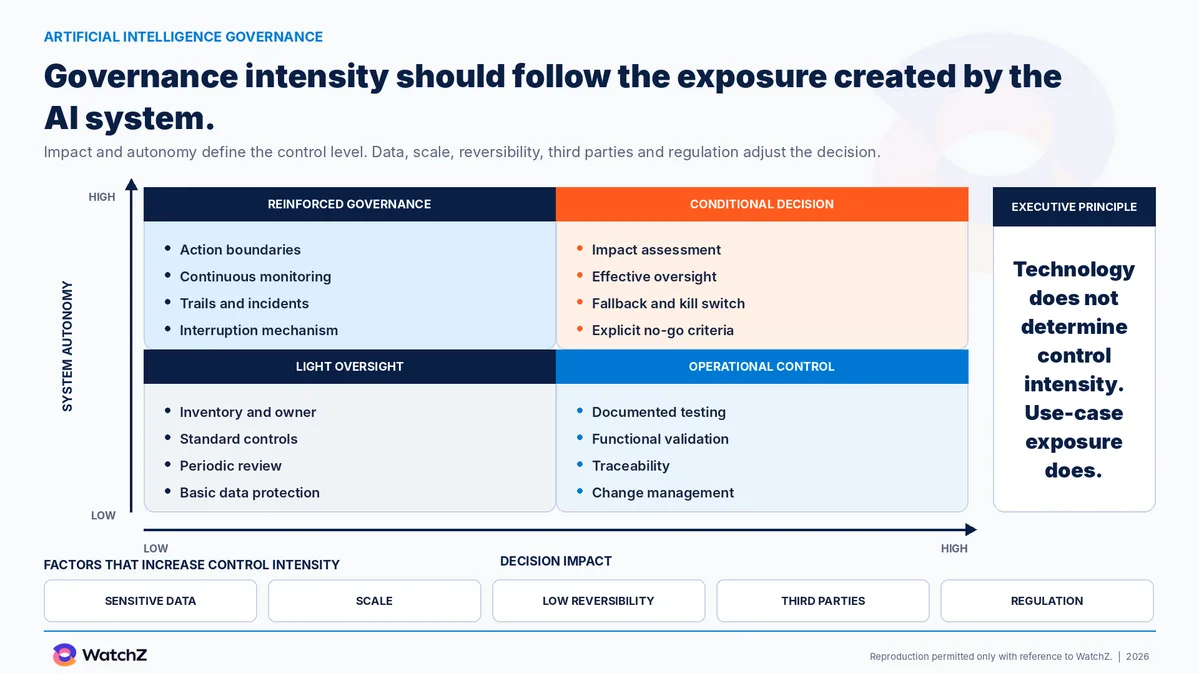
The matrix does not replace judgment. Five modifiers may increase control intensity: sensitive data, scale, low reversibility, third-party dependency and regulation. A system initially classified as operational control may move to conditional decision when it operates across millions of transactions, uses highly sensitive data or produces effects that cannot be repaired quickly.
Proportionate control requires minimum standards by class
Governance scales when requirements are no longer negotiated from scratch. Each matrix zone should have a minimum package of controls, evidence and decision rights. The package may include a purpose statement and prohibited uses, quality and performance criteria, impact and affected-group assessment, documentation of data, suppliers and limitations, security and misuse testing, human oversight criteria, autonomy and permission boundaries, monitoring, alerts and review triggers, incident and exception records, and continuity, fallback and retirement requirements.
Proportionality avoids two forms of waste. The first is applying heavyweight controls to low-exposure cases. The second is approving critical systems with the same evidence required for administrative automation.
Governance must span the lifecycle
Policy becomes real only when it follows the system from intake to retirement. A governed lifecycle includes eight stages.
- Intake and triage. Record purpose, owner, context, data, autonomy and expected impact.
- Risk mapping. Identify affected people, processes and assets and classify exposure and residual risk.
- Design and acquisition. Select architecture, suppliers, contracts, data, controls and boundaries.
- Pre-use evaluation. Test performance, security, robustness, relevant bias, adversarial behavior and fallback capability.
- Approval. Record evidence, exceptions, owners and production-entry conditions.
- Operations and monitoring. Observe quality, behavior, incidents, version changes, cost, use and purpose alignment.
- Review and change. Reassess when scope, supplier, model, data, population or autonomy changes.
- Retirement. Deactivate through explicit criteria, preserve required evidence and revoke access.
The NIST Generative AI Profile reinforces the need for clear roles, pre-deployment testing, continuous monitoring, incident reporting and approval criteria aligned with generative-AI-specific risks.
Platform and engineering turn policy into executable control
Manual governance cannot keep pace with distributed adoption. As the portfolio grows, controls must be embedded in the platforms and delivery paths used by teams. Reusable capabilities may include automated inventory registration, assessment and evidence templates, model and API gateways, dedicated identities for agents, secrets management and least privilege, versioning of prompts, models, data and policies, evaluation suites before and after deployment, filters, guardrails and policy-as-code, decision and action logs, observability for quality, cost, security and behavior, and incident, pause and rollback workflows.
This layer lowers the marginal cost of governance. Teams do not need to rebuild controls for every project. They use standardized components and produce evidence continuously.
Platform does not remove accountability. Automating a poor control only scales fragility. The correct sequence begins by defining the decision and accountability, then setting the criterion, instrumenting it and only then automating.
Data, security and third parties are part of the governance system
AI governance depends on data governance, security and supplier management, and adds requirements specific to the decision context. For data, the organization must understand origin, purpose, quality, usage rights, retention, sensitivity, representativeness and lineage. For security, it must address access, isolation, information extraction, prompt injection, tool abuse, behavioral changes, component dependency and incident response.
For acquired systems, the organization remains accountable for the deployment context. Contracts and due diligence should clarify which data is processed and retained, how versions and behavior may change, which evidence and logs are available, how incidents will be communicated, which subcontractors participate in the chain, how portability or discontinuation works and what limitations exist for audit and explainability.
Outsourcing the model does not outsource business exposure.
Human oversight must be designed, not assumed
Putting a human in the loop is not, by itself, a sufficient control. Oversight is effective only when the person has enough information to understand the context, has time and competence to review, can disagree with the system without operational penalty, has authority to stop or reverse the action, receives cases that genuinely require judgment and is not exposed to a volume that turns review into automatic confirmation.
In some cases, the better decision is to limit autonomy. In others, it is to prohibit the use. Mature governance recognizes that not every exposure can be compensated for by more monitoring.
Governance lowers the cost of uncertainty rather than creating ROI
It is inappropriate to promise that governance alone accelerates returns. ROI depends on problem selection, adoption, process redesign, data, integration, total cost and execution capability.
The economic contribution of governance is more precise. It may reduce the cost of uncertainty and repetition. Known criteria reduce approval rework. Reusable evidence reduces audit effort. Platform controls reduce duplicated implementation. Monitoring and response may limit the duration and reach of failures.
Executive metrics should separate three dimensions. In coverage, the percentage of systems and use cases registered, with defined owners, with third parties and versions mapped and with current classification. In exposure and control, the distribution by risk zone, the volume of high-materiality decisions or actions, the percentage with adequate monitoring and fallback, the open exceptions with accepted residual risk and the incident detection, containment and remediation time. In value and efficiency, the use-case outcome versus baseline, the total operating cost, the approval time by class, the evidence and audit cost, the rework avoided through reusable components and the systems retired because of low value or disproportionate risk.
Governance becomes executive when the same dashboard shows captured value, accepted exposure and control effectiveness. Prioritization by economic criteria helps decide where to reinforce control first.
Regulation is a design context, not a fear tactic
The NIST AI RMF is voluntary guidance, not a legal obligation. ISO/IEC 42001 defines requirements for a management system and may support certification, but it does not replace analysis of applicable law.
In the European Union, the AI Act establishes risk-based rules and differentiated obligations according to actor role and system category. The regulation entered into force on 1 August 2024, with phased application. Prohibitions on unacceptable practices and the AI literacy duty took effect in February 2025. Rules for general-purpose models followed in August 2025.
The simplification package known as the Digital Omnibus entered into force on 27 July 2026 and deferred the high-risk obligations. Standalone Annex III systems moved to 2 December 2027. Systems embedded in regulated products under Annex I moved to 2 August 2028. Article 50 transparency rules and the Article 4 literacy duty stayed where they were.
The deferral strengthens the argument rather than weakening it. Organizations that treated August 2026 as a single compliance date rebuilt the plan in July. What matters is tracking the current version of the rules instead of tying the operating model to a calendar that moves.
In Brazil, Bill 2338/2023 remained in the Chamber of Deputies special committee in August 2026, awaiting the rapporteur's opinion, with 35 bills attached for joint review. In parallel, the Brazilian Data Protection Authority's 2025-2026 Regulatory Agenda includes artificial intelligence and review of automated decisions in connection with personal-data protection and Article 20 of the LGPD.
Corporate governance should not wait for every regulation to be finalized. It should build the capability to identify jurisdictions, map obligations, produce evidence and adapt controls without rebuilding the operating model after each legal change.
A first-wave roadmap to move beyond policy
An initial implementation can be organized into four moves.
Days 1 to 20, define scope and accountability. Establish executive sponsorship and a decision forum, approve a taxonomy for systems, use cases, decisions and agents, define impact, autonomy and modifier criteria, and select two or three priority areas for discovery.
Days 21 to 45, build the minimum viable inventory. Integrate information from architecture, procurement, security, data and product, register systems that are built, bought and used by business teams, assign owners and identify gaps, and classify them preliminarily through the matrix.
Days 46 to 70, define control packages. Establish minimum requirements by zone, create assessment, approval, exception and incident templates, define decision rights and pause or no-go criteria, and select one use case from each zone to validate the controls.
Days 71 to 90, instrument and report. Embed records, evidence and monitoring into existing delivery paths, define a coverage, exposure, control and value dashboard, correct gaps identified in the pilot and approve the platform and expansion roadmap.
The objective of the first wave is to establish a minimum system capable of learning, prioritizing and evolving through evidence, not to declare governance complete.
Conclusion
The organization does not need another committee to discuss artificial intelligence. It needs an operating model that makes explicit what is in use, what decision or action is being influenced, who is accountable, what exposure has been accepted and how the system can be monitored, restricted or retired.
Counting models is administratively simple but strategically insufficient. Control intensity should track impact and autonomy, adjusted for scale, data, reversibility, third parties and regulation.
AI governance creates value when it lowers the cost of decision-making and increases the ability to operate under uncertainty. It does not guarantee return and it does not eliminate risk. It does something more useful. It turns diffuse exposure into accountability, evidence and executive decision. The same proportionality governs the human side of the operation, where leading hybrid teams of people and AI agents means distributing autonomy without diluting responsibility. A capability assessment shows where control intensity is misaligned with exposure before the next AI adoption cycle.
Sources
- NIST. "AI Risk Management Framework". https://www.nist.gov/itl/ai-risk-management-framework
- NIST. "AI Risk Management Framework (AI RMF 1.0)". https://nvlpubs.nist.gov/nistpubs/ai/nist.ai.100-1.pdf
- NIST. "AI RMF Core" (Govern, Map, Measure and Manage). https://airc.nist.gov/airmf-resources/airmf/5-sec-core/
- NIST. "AI 600-1 - Generative Artificial Intelligence Profile". https://www.nist.gov/publications/artificial-intelligence-risk-management-framework-generative-artificial-intelligence
- ISO/IEC. "ISO/IEC 42001:2023 - Artificial intelligence management systems". https://www.iso.org/standard/42001
- OECD. "Advancing accountability in AI". https://oecd.ai/en/accountability
- OECD. "AI Accountability Principle". https://oecd.ai/en/dashboards/ai-principles/P9
- European Union. "Regulation (EU) 2024/1689 - Artificial Intelligence Act". https://eur-lex.europa.eu/eli/reg/2024/1689/oj/eng
- European Commission. "Regulatory framework for AI - implementation and timeline". https://digital-strategy.ec.europa.eu/en/policies/regulatory-framework-ai
- European Commission. "Digital Omnibus" (simplification package amending the AI Act, in force 27 July 2026). https://digital-strategy.ec.europa.eu/en/policies/digital-omnibus
- Brazilian Data Protection Authority (ANPD). "2025-2026 Regulatory Agenda" (includes artificial intelligence and review of automated decisions). https://www.gov.br/anpd/pt-br/assuntos/processo_regulatorio/agenda-regulatoria-1/agenda-regulatoria-2025-2026
- Brazilian Chamber of Deputies. "Bill 2338/2023 - legislative status" (status accessed on 17 August 2026). https://www.camara.leg.br/proposicoesWeb/fichadetramitacao?idProposicao=2487262
- WatchZ. "AI governance should start with exposure, not model count". Revised editorial version, August 2026.
Note: legislation and regulatory timelines change. The regulatory statements are dated 17 August 2026 and should be checked against the current version before decisions. This material offers strategic and architectural analysis, not legal, regulatory or audit advice.