

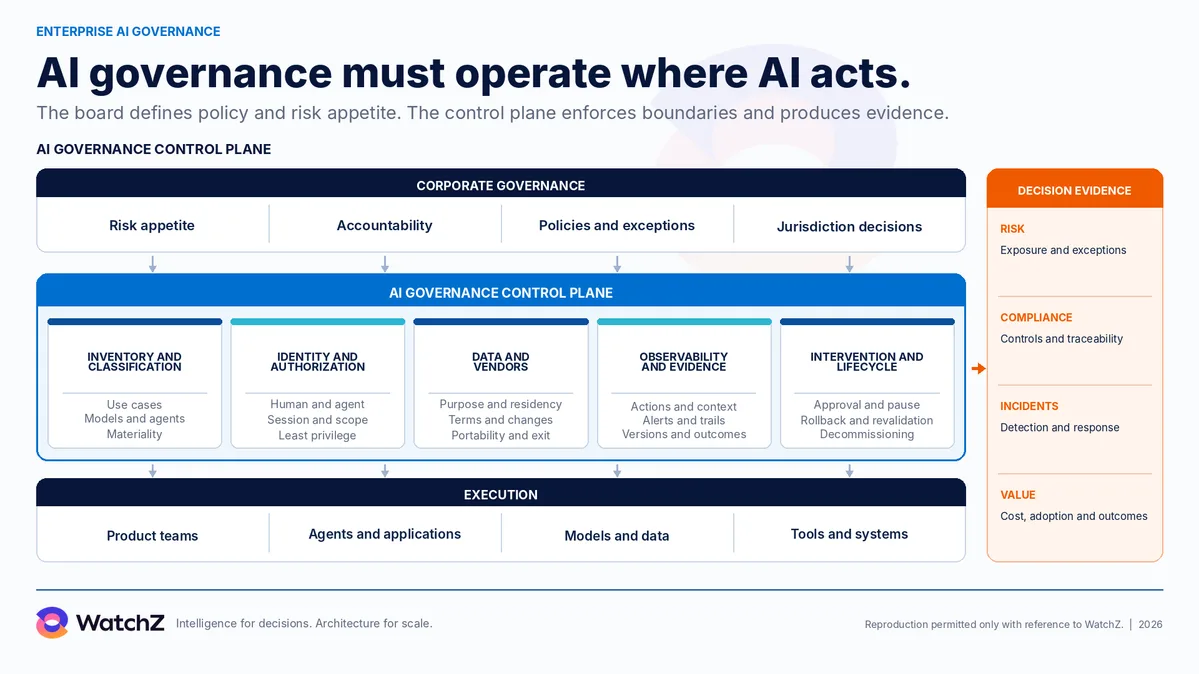
The board defines risk appetite, accountability, and exceptions. Architecture enforces boundaries, records evidence, and stops actions when necessary.
AI governance does not become obsolete because a committee exists. It becomes insufficient when policy decisions remain in documents and meetings instead of being translated into verifiable controls at execution time.
The problem becomes more consequential when an organization moves beyond AI-generated recommendations and allows agents to query data, invoke tools, initiate transactions, and modify systems. In this environment, the governed unit becomes the chain formed by the delegating human, the agent, the execution session, the model or version, the data used, the tool invoked, and the resulting effect, not only the model.
The NIST AI Risk Management Framework organizes risk management around Govern, Map, Measure, and Manage, and states that risk management should be continuous across the AI system lifecycle. ISO/IEC 42001 structures AI governance as a management system that must be established, maintained, and continually improved. Neither reference requires a product called a control plane. The consulting inference in this article is that organizations with material AI portfolios need a reusable control layer to translate policy into operational behavior.
Rigor note. Fact: the risks, regulations, and frameworks cited in the references. Consulting inference: the control layer as an architectural pattern. Opinion: the proposed distribution of responsibilities in the operating model. Risk: applying the design without proportionality, operating capability, or legal validation.
The governed object is no longer only the model
A model inventory remains necessary, but it no longer describes the full exposure. An agentic system may combine a third-party model, memory, corporate data, APIs, tools, instructions, credentials, and orchestration mechanisms. Risk emerges from the interactions among these components, not only from the model's statistical quality.
NIST's NCCoE is exploring standards-based approaches to identify agents, manage their authority, and control the actions they can take. The project is explicitly presented as evolving work, showing that the direction is relevant while standardization is not yet complete. OWASP also highlights risks such as tool abuse, privilege escalation, data exfiltration, excessive autonomy, and irreversible actions without independent validation.
The practical implication is to separate four objects that are often conflated:
- Delegating human. The person who requested, sponsored, or authorized the activity.
- Agent. The software entity that plans and executes actions.
- Session or workload. The temporary context in which credentials, data, and tools are used.
- Model and version. The probabilistic component that produces inferences, including provenance and configuration.
Identifying these objects does not mean assigning a model the same security identity as an agent. It means ensuring that the organization can reconstruct who initiated an action, what authority was delegated, which version participated, which resources were accessed, and what outcome was produced.
The committee does not disappear; its role changes
Corporate governance remains responsible for matters that cannot be reduced to a technical rule: risk appetite, accountability, ethical boundaries, investment priorities, material exceptions, regulatory posture, and decisions to enter or exit markets.
The mistake is to use that body as the primary mechanism for every authorization, review, and piece of operational evidence. Committees are appropriate for judgment, challenge, and direction. They are not designed to manually verify thousands of distributed actions or respond to events that require immediate containment.
A more robust operating model distributes governance across three layers. Corporate governance defines policy, accountability, risk appetite, and exception criteria. The control layer translates repeatable rules into identity, authorization, data, observability, evidence, intervention, and lifecycle services. Execution covers product teams, agents, applications, models, data, and systems operating within those boundaries.
This separation does not reduce human accountability. It clarifies where judgment is required and where the organization can enforce controls consistently.
Runtime governance does not mean controlling every inference the same way
A simplified version of the debate says governance moved from the quarterly meeting to every inference. The direction is useful, but the formulation is incomplete. Not every inference warrants the same level of control, latency, logging, or intervention. Control cadence should follow risk materiality.
Preventive controls. Before production, the organization classifies the use case, assesses impact, validates data, assigns ownership, reviews vendors, tests threats, and defines pause and decommissioning criteria.
Execution controls. At action time, higher-risk systems may require authentication, contextual authorization, tool restrictions, human confirmation, segregation of duties, or blocking of irreversible operations.
Continuous monitoring. Telemetry tracks behavior, incidents, cost, latency, quality, drift, policy violations, and dependency changes. Continuous monitoring does not mean indiscriminately storing all content. Retention, privacy, and purpose must also be governed.
Periodic oversight. Committees and independent functions review the portfolio, exceptions, incidents, residual risks, regulatory changes, control effectiveness, and vendor continuity.
A mature design combines all four cadences. Automating everything creates false confidence. Reviewing everything manually creates delay and an illusion of coverage.
Data sovereignty and jurisdiction are multidisciplinary decisions
AI regulation is not moving along a single path. The European Union uses a risk-based framework and phased application, and its implementation timeline continued to be adjusted in 2026. Data protection requirements also depend on purpose, legal basis, party roles, identifiability, development context, and deployment context. The European Data Protection Board emphasizes that questions involving AI models trained with personal data require case-by-case assessment.
For that reason, data location, training, hosting, and inference are relevant, but they do not act as universal legal triggers when viewed in isolation.
The enterprise decision must integrate data classes and purposes, affected markets and individuals, storage and processing locations, controller, processor, provider, and integrator roles, international transfer and access possibilities, vendor terms and contract changes, auditability, portability, and exit capability, and the criticality and reversibility of automated decisions.
The board should define risk appetite and deliberate on material exposures. Legal, privacy, security, data, architecture, procurement, and business teams must translate that direction into operating standards. Treating the issue only as architecture is as inadequate as treating it only as compliance.
The control layer must operate as a platform product
The control layer does not need to be a single system or a new centralized bureaucracy. It may be a composition of integrated services with clear interfaces, ownership, adoption metrics, and continuous evolution. Its minimum core will typically include five capabilities.
Inventory and classification. A living record of use cases, models, agents, data, vendors, owners, purpose, materiality, and lifecycle status.
Identity and authorization. The relationship among the delegating human, agent, session, tools, and resources, with least privilege, short-lived credentials, scope limits, approval for higher-impact actions, revocation, and non-repudiation where appropriate.
Data and vendor policy. Rules by data class, purpose, jurisdiction, and provider, with residency and transfer controls where needed, contractual requirements, versioned terms, portability, and continuity.
Observability and evidence. Records of actions, context, authorizations, versions, outcomes, alerts, and interventions. This evidence improves investigation and auditability, but it should not automatically be confused with causal explainability or sufficient regulatory proof.
Intervention and lifecycle. Pause, containment, human review, rollback, vendor replacement, revalidation, decommissioning, and disposal of data or credentials.
Team Topologies provides useful organizational language. Platform teams create services that remove complexity for stream-aligned teams, while enabling teams support capability adoption. The framework does not prescribe artificial intelligence governance. Its use here is an operating-model inference.
The economic benefit is real, but not automatic
Governance increases initial investment. Non-human identity, observability, classification, policy, testing, audit, and vendor management all have a cost. Denying that cost weakens the business case.
Potential value appears when the organization stops rebuilding controls for every initiative and starts reusing trusted capabilities. Under those conditions, the control layer may reduce the marginal friction of new use cases, accelerate evidence production, standardize decisions, and reduce rework.
The economics depend on explicit conditions. A portfolio large enough to justify reuse. Self-service capabilities with a strong internal experience. Integration into the delivery flow rather than a parallel queue. Product ownership and funding. Actual adoption by delivery teams. Controls proportional to risk. Metrics that compare cost, time, exposure, and outcomes before and after implementation.
A platform without internal customers becomes expensive infrastructure. A policy without execution mechanisms remains an intention. The economic objective is to combine the two without creating another dependency layer. Prioritization by economic criteria helps decide where to begin.
A defensible operating model distributes accountability
Accountability must not disappear inside the platform. Each layer has a distinct obligation.
- Board and executive leadership. Risk appetite, accountability, material decisions, investment, and oversight.
- AI governance committee or function. Taxonomy, policies, risk criteria, exceptions, challenge, and portfolio view.
- Legal, privacy, risk, and audit. Interpretation, independent control, and evidence validation.
- Platform, security, data, and architecture. Reusable services, guardrails, integration, reliability, and telemetry.
- Product and business teams. Purpose, context, outcomes, quality, human oversight, and residual use-case risk.
- Enabling teams. Temporary capability building and knowledge transfer.
The principle is straightforward. Those who define policy should not depend on a spreadsheet to know whether it was applied. Those who deliver value should not rebuild foundational controls. And those who operate the controls should not decide alone which risks the enterprise accepts.
How to start without a big-bang transformation
The transition can begin through an incremental cycle.
- Create a living inventory connecting the use case, model, agent, data, vendor, owner, and purpose.
- Classify materiality based on autonomy, data sensitivity, impact, reversibility, scale, and regulatory exposure.
- Prioritize the highest-risk flows rather than applying the same depth of control everywhere.
- Define the identity and authority boundary among the human, agent, session, model, and tool.
- Implement the minimum control plane, beginning with authorization, records, alerts, intervention, and lifecycle.
- Integrate controls into the delivery flow through consumable standards and explicit exceptions.
- Review effectiveness and economics, comparing adoption, approval time, incidents, rework, operating cost, and residual risk.
There is no universal count of warning signs or coverage percentage that defines maturity. The right question is whether materially relevant use cases have ownership, boundaries, evidence, oversight, and interruption capabilities proportionate to their risk.
Questions leadership should answer
- Which AI systems can act rather than merely recommend?
- Who delegates authority to each agent, and for how long?
- Which actions require confirmation or segregation of duties?
- Which data and tools are out of reach by default?
- What evidence is required to investigate a critical decision?
- How are model, vendor, or contractual changes detected and approved?
- Who can pause, reverse, or decommission the system?
- What residual risk remains, and who formally accepts it?
- Is the cost of control proportionate to the value and exposure of the use case?
Conclusion
The future of enterprise AI governance is an accountability architecture in which human judgment and technical control occupy different and complementary roles, not a committee replaced by automation.
The board continues to define what the enterprise accepts. The committee continues to challenge, prioritize, and oversee. Legal, risk, and audit continue to interpret obligations and test evidence. What changes is that repeatable rules no longer exist only in documents. They begin to constrain actions, record context, and trigger intervention in operations.
A mature organization does not try to govern every inference in a meeting. It also does not delegate critical decisions to a platform without accountability. It builds a control layer proportionate to risk, integrated into the delivery flow, and capable of producing evidence for decisions. A capability assessment shows where that layer must exist before the next AI investment cycle.
Governance stops being a stage when it becomes a capability. And it only becomes a capability when it works where AI acts.
Sources
- NIST. "AI Risk Management Framework Core" (Govern, Map, Measure, and Manage functions; continuous risk management across the lifecycle). https://airc.nist.gov/airmf-resources/airmf/5-sec-core/
- NIST NCCoE. "Software and AI Agent Identity and Authorization". https://www.nccoe.nist.gov/projects/software-and-ai-agent-identity-and-authorization
- OWASP Foundation. "AI Agent Security Cheat Sheet". https://cheatsheetseries.owasp.org/cheatsheets/AI_Agent_Security_Cheat_Sheet.html
- European Commission. "AI Act - Regulatory framework and application timeline". https://digital-strategy.ec.europa.eu/en/policies/regulatory-framework-ai
- European Data Protection Board. "Opinion 28/2024 on certain data protection aspects related to the processing of personal data in the context of AI models" (Dec 18, 2024). https://www.edpb.europa.eu/documents/opinion-of-the-board-art-64/opinion-282024-on-certain-data-protection-aspects-related-to_en
- ISO/IEC. "ISO/IEC 42001:2023 - Artificial intelligence management system". https://www.iso.org/standard/42001
- Team Topologies. "Key concepts and practices" (stream-aligned, platform, and enabling teams). https://teamtopologies.com/key-concepts
- WatchZ. "Enterprise AI governance must operate where AI acts". Revised editorial version, July 2026.
Legal note: this material offers strategic and architectural analysis. It does not constitute legal, regulatory, or audit advice. Requirements must be validated for the specific jurisdiction, sector, and use case.