


The biggest fragility in measuring technology ROI is not in the formula. It is in the calendar. When the return only appears after the investment, measurement stops being a management discipline and becomes a story chosen to explain the number that showed up.
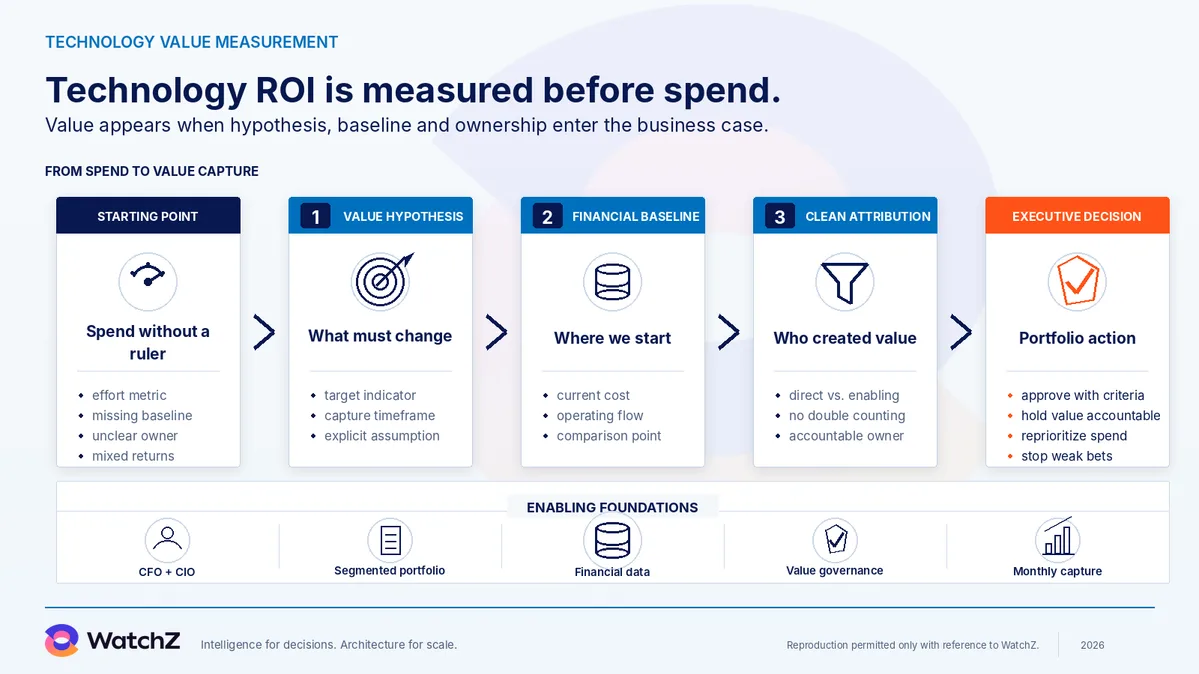
Defensible ROI starts before the spend. It is born as a management hypothesis. Which business indicator should move, which baseline will be used, in what window the gain will be observed and who answers for the capture. That agreement changes the executive conversation. Leadership stops asking whether technology was delivered and starts asking whether the economic promise was captured.
The path to measuring without guesswork has four moves. Declare the hypothesis before investing, fix the baseline before the first change, separate direct return from enabling return, and measure capability as a flow. The order matters, and the reason so much measurement targets the wrong thing comes last.
ROI begins before the approval
Measurement and wishful thinking part ways on the calendar. ROI declared before the spend is a management hypothesis, with an indicator, a deadline and an owner that can be held to account. ROI built after the fact is a story chosen to fit the number that appeared.
The difference is material. Market research on digital initiatives shows that only 48% meet or exceed their business outcome targets, while the best-performing group reaches 71%. The executive reading is direct. Technology does not fail only from poor technical execution. It fails when business and technology do not co-own value delivery from the origin. In practice, the accountability fits in one board question. Who answers for the number this initiative promised to move?
The baseline is the reality contract
Every ROI promise needs a starting point. What it costs to run the journey today. What the current lead time is. How many incidents create financial impact per quarter. How much engineering effort goes to maintenance instead of evolution. What unit cost the operation carries before the change.
Without a baseline, the company measures perception. It may even have improved, but it cannot prove it. It may have cut cost in one area and added friction in another. It may have accelerated delivery without capturing margin. It may have bought nominal productivity without converting productivity into cash, margin, reduced risk or a better experience.
A global study of digital and AI transformations shows the size of that distance. Large companies captured, on average, 31% of the expected revenue gain and 25% of the expected cost savings. The critical point is not to treat that number as an inevitable destiny. It is to recognize that planned value and realized value are different disciplines. Without a baseline and a capture mechanism, the difference becomes political noise. A structured capability diagnosis fixes that baseline before the first dollar is spent.
Direct return and enabling return do not fall into the same account
Calculating ROI is simple when the benefit goes straight to cash. Shutting down a redundant system, reducing licenses, consolidating infrastructure or eliminating a manual operation with an explicit cost tends to generate direct return. The benefit has an owner, a financial line and a capture mechanism.
Many technology capabilities work as enablers. A data platform speeds a commercial decision. Observability reduces operational risk. Platform engineering reduces delivery friction. Security contains financial exposure. Those returns exist, but they ask for a different yardstick. Their own capture window, a link to the workflow and a prior agreement on how the gain will be recognized.
The most expensive mistake is adding everything up as if it had the same nature. When the same benefit appears as cost reduction, productivity gain and revenue growth, the business case loses credibility at the CFO's first challenge. The technology portfolio has to separate what keeps the operation running, what reduces risk, what improves efficiency and what moves growth. Portfolio prioritization with economic criteria depends on this hygiene.
An activity metric is not a return
Availability, deploy frequency, a clean backlog and resolved tickets are useful metrics for operating technology. They show flow, stability and delivery capability. But they do not prove financial return on their own.
The DORA program, from Google Cloud, treats delivery metrics as instruments to understand software performance and guide continuous improvement. The approach itself reinforces context, multiple metrics and the risk of turning one indicator into an isolated target. That nuance is decisive. Engineering metrics can be leading indicators of value, but they only become ROI when connected to an economic hypothesis.
The executive question is not how many deploys were made. It is what result those shorter cycles were supposed to move and what was actually captured. Without that bridge, the company trades value management for theater of productivity.
Capability ROI is a flow, not an event
Projects have a beginning, a middle and an end. Capabilities do not. Data, platform, security, architecture, engineering and reliability operate continuously. That is why they cannot be measured only at the closing of a project or the final presentation of a program.
A capability generates return when it reduces unit cost over time, speeds decisions, lowers operational risk, increases predictability, reduces rework or sustains growth without raising cost at the same rate. That return has to reappear in the monthly tracking. When the capability stops being measured, it reverts to being perceived as expense.
A market analysis captures the trap. Technology value stays invisible because capabilities advance faster than workflows change, and workflows change faster than the company can capture the gain. Without a deliberate capture system, the value arrives late, indirectly and easy to contest. It is the same logic that separates modernization that moves results from modernization that merely swaps technology.
The executive decision has to change
Measuring technology ROI does not require a sophisticated financial model before any initiative. It requires management discipline. Before approval, four questions need to be answered. Which indicator will move, which baseline will be used, which mechanism separates direct return from enabling return and who answers for the capture.
That logic changes the role of the CIO and the CFO. The CFO does not step in to slow technology down. They step in to make the economic promise clear. The CIO does not step in to defend spend. They step in to manage a portfolio of capabilities, with distinct criteria for operating, reducing risk, improving efficiency and creating competitive advantage.
Research among executives indicates that six in ten find it hard to quantify the benefits of individual technology investments. That explains why so many budgets are defended by conviction. When margins tighten, conviction loses ground to cash, risk and provable return.
Conclusion
Technology ROI is not an account drawn up after the project. It is a management contract signed before the decision. Indicator, baseline, attribution, owner and capture window form the minimum line of economic governance.
Mature companies do not approve technology just because the initiative looks modern, urgent or inevitable. They approve when the value promise is clear enough to be collected. The next investment approval that crosses your desk is the test. Indicator, baseline and owner defined before the spend, or the return will be narrated afterward. And narration is not measurement.
Sources
- Gartner. "Only 48% of Digital Initiatives Meet or Exceed Their Business Outcome Targets". Press release, 22 Oct. 2024.
- Deloitte Insights. "From tech investment to impact: Strategies for allocating capital and articulating value". 2023 Global Technology Leadership Study.
- McKinsey. "Rewired for value: Digital and AI transformations that work". 31 Jul. 2023.
- DORA / Google Cloud. "DORA's software delivery performance metrics". Updated 5 Jan. 2026.
- BCG. "How CIOs Can Prove the Value of Tech in the Age of AI". 8 Jun. 2026.