

Artificial Intelligence
Need help adopting artificial intelligence in your company? WatchZ starts from the process AI will change. The first case reaches production with measured return and with decision rights defined.
Do you recognize this scenario?
Three typical situations in mid-market and enterprise organizations that do not yet operate this capability as a system.
PoCs that never reach production
The pilot impresses. The board approves. Six months later, it is still in staging. The production criteria were never defined. The return was never promised with a real number.
AI being used without control
Each team uses the model they prefer. Client data is pasted into public tools. Decisions are made based on answers the model invented. Nobody knows what is being used or with which data.
Business team blocked waiting on IT
Legal wants to automate contract review. Finance wants AI for anomaly detection. Both are in the IT backlog. The initiative waits while competitors operate.
Nobody measures the return of AI initiatives
The AI budget grows. The number of projects grows. Measurable results do not grow. Without economic criteria per initiative, AI becomes a cost center with different vocabulary.
Risk and compliance became a board alert
Data protection regulation, personal data use, bias in automated decisions, agent behavior in production. The board asks who is responsible. The answer does not come with clarity.
Agents in pilot without behavior governance
The agent works in the test environment. In production, it accesses data it should not, executes actions outside the expected scope and nobody has visibility into what happened.
Five maturity levels, at your own pace
Nothing here is set in stone. In AI, the assessment places the company at one of these five levels and shows the gap to the next. The climb follows the appetite, urgency and value of each front, and the first result shows up within the first days.
Initial
AI happens through isolated initiatives. No one defines who decides on risk or which data can be used, adoption runs outside in unauthorized tools, and what reaches production answers from what the model memorized, with no monitoring.
Managed
Minimum governance enters the picture. The company defines who decides on AI, who owns risk and which data can be used. The first initiatives leave improvisation behind, but adoption, portfolio and architecture are still fragile.
Defined
AI reaches the business with method. Business teams adopt copilots with guardrails, unauthorized use recedes and the portfolio gets prioritized by revenue, cost and margin instead of demo enthusiasm.
Quantified
Architecture sustains scale. Answers rest on verifiable internal data, the first agents connect to systems and engineering gains speed with specification-driven development. The cost and return of each case start being measured.
Optimized
Agents run end-to-end processes with traceability and human oversight at the highest-impact points. Operations track degradation and quality in production, and AI becomes a continuous lever for revenue and cost, not a one-off project.
The dimensions we assess
AI maturity is a set of dimensions that must evolve together. We measure each one in the diagnostic before defining where to start.
Strategy
AI vision, use cases prioritized by value, and a continuous refinement process.
Value
Portfolio by revenue, cost and margin. Cost of use and return monitoring.
Governance
Decision rights, risk, compliance and monitoring of models and agents.
Adoption and culture
Copilots, guardrails, literacy and role redesign. End of shadow AI.
Architecture
RAG, agents, MCP and spec-driven development. Build vs buy criteria.
Engineering and operations
Model lifecycle, reliability, observability and AI inside engineering.
Data
AI-ready data, quality and data observability in production.
Use cases
Where this capability already delivers, from business teams to operations. This list is only a starting point, the cases are many.
Software engineering acceleration
Spec-driven development, code generation and review, automated tests and documentation. The team ships faster without lowering the bar, with human review at each step.
Real-time fraud detection
Risk scoring on every transaction, in real time, combining history, behavior and network signals. Blocking before the loss and less friction for the legitimate customer.
Demand forecasting and inventory optimization
Forecasting by product and by store combining history, seasonality and external signals. Buying and replenishment at the right level, with no stockout or excess.
Dynamic pricing
Price adjusted by product, channel and moment based on demand, competition and elasticity. Pricing stops being a monthly spreadsheet and becomes a continuous capability.
Personalization and recommendation
Personalized recommendations and offers per customer, on the site and across channels, based on real behavior and available stock.
Customer service automation
Triage, response and routing of customer tickets grounded in the company internal knowledge. Answers in seconds, with a verifiable source and escalation when needed.
Internal support automation
AI resolves common internal questions and requests (IT, HR, processes) end to end and routes to a human only what needs judgment. Less queue and instant answers.
Document processing
Extraction and validation of data from contracts, invoices, forms and proposals, with automatic checks against rules and systems. Less typing and fewer transcription errors.
Accounts payable automation
Invoice extraction, validation and processing without manual intervention at each step, with complete traceability from start to payment.
AI-assisted financial forecasting
Models that combine internal history with market patterns to forecast demand, revenue or cost with a confidence interval. Allocation decisions based on data, not intuition.
Human Resources
Resume screening, interview scheduling, role-based onboarding material and answers to policy questions. Less repetitive work and faster onboarding.
Knowledge management
RAG over the internal base. The team finds the right answer in seconds, grounded in the correct document, without depending on a meeting or one person memory.
Agents for end-to-end processes
Multi-step processes executed by agents that access systems, verify data, decide within defined criteria and record each action for audit. Human supervision at the highest-impact points.
What do you want to do with AI? Tell us your case and we assess the return before starting.
Talk about your caseThe 5 pillars of Artificial Intelligence
The fronts that make up the capability, from foundation to evolution. Each one matures in its own time, within the same system.
AI Governance
Decision structure that converts AI from accumulated risk into scalable capability. Who authorizes, who answers and what is monitored in production.
Business Team Adoption
AI adopted safely by non-technical teams, with copilots, guardrails and training that sustain real daily use.
AI Value and Portfolio
Each AI initiative connected to defensible financial return, with prioritization criteria and portfolio discipline that eliminates the eternal PoC.
AI Architecture
Architecture that connects AI models to company internal data and tools, with patterns that ensure traceability and reliability in production.
AI Operations and Reliability
Models and agents in production with real observability, retraining criteria and supervision that prevents decisions based on degraded AI.
Consulting enters when the criteria must exist before the first use case
AI governance and prioritization decide where the investment pays back. WatchZ brings the criteria ready, applies them to your processes and hands them to your team.
- Use case map with affected process, volume and estimated gain in revenue or cost
- Governance model naming who authorizes, who answers for risk and what is monitored in production
- Architecture over the internal data of the company, with inference cost calculated before scaling
- Adoption plan by role, so business areas operate AI with clear criteria and autonomy

An agent in production raises four practical questions
Each one has a written answer, with the criteria we apply.
Autonomy of AI agents
Where the line sits between what the agent settles alone and what it must escalate.
AI agent reliability
What happens when the agent gets it wrong, and how far that error travels.
AI agent identity
How the record separates what the person did from what the agent did on their behalf.
Human oversight in AI agents
Four ways to put people in the loop, and what each one costs.
Clients
Market leaders evolve their capabilities with us. Organizations that turned technology capability into defensible financial result.




















What we wrote about Artificial Intelligence
Capability, governance and result. Concrete analysis to help technology and business leaders defend investment with thesis, not slides.

Acting on someone's behalf does not require using that person's credential
The log shows that Ana changed the data. The line is true and answers nothing, because the one that executed may have been her agent. When a person and an agent appear as the same identity, the company loses the chain and loses with it the ability to treat the two differently.

An AI agent's success rate does not measure the risk it carries
Two agents with the same success rate carry different risks when one executes ten actions a month and the other executes thousands. What sets the size of the problem is the gap between the first failure and containment, and the three stages that exist only if someone designed them.
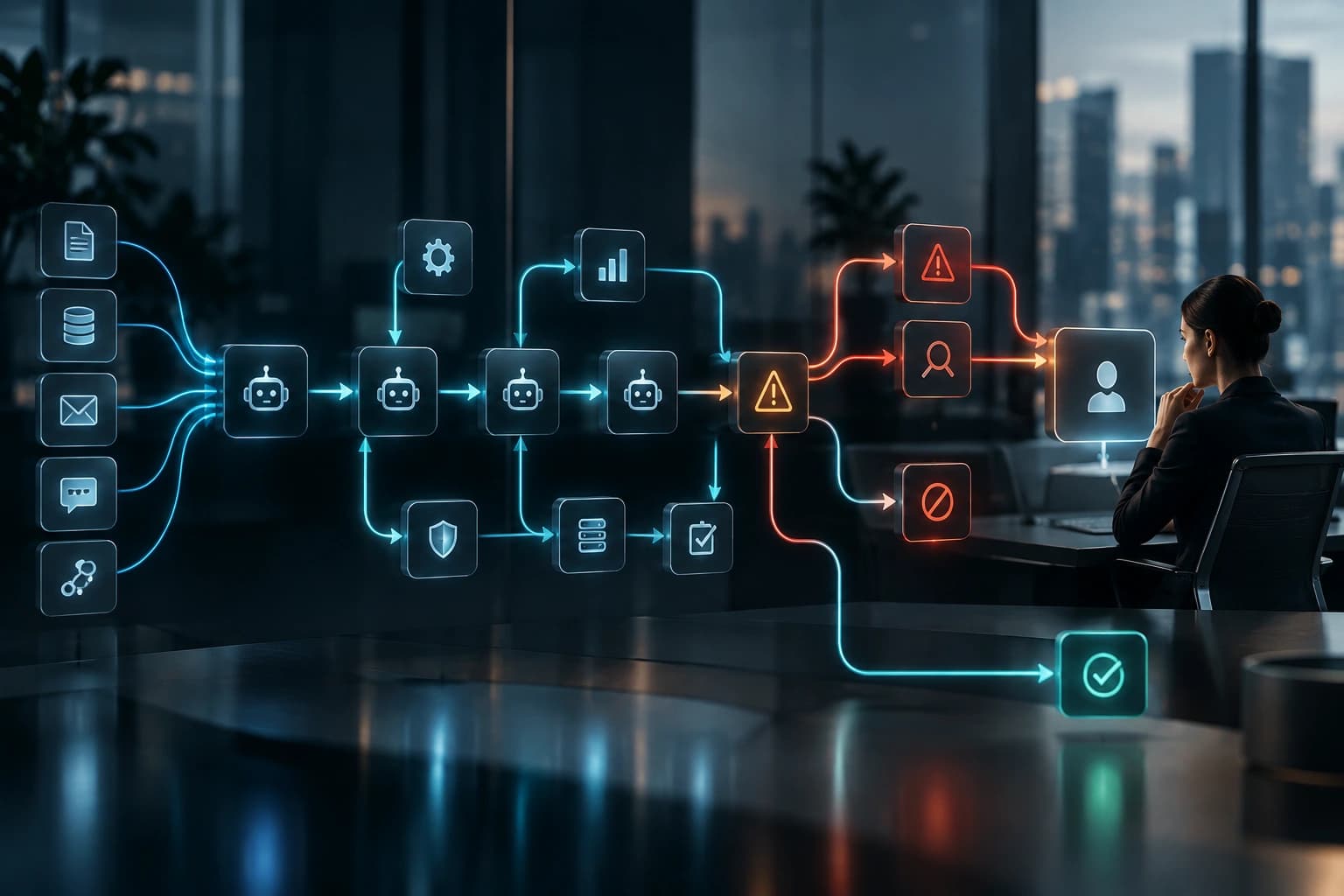
Approving everything is the most expensive way to supervise an AI agent
Human attention is a finite resource with a price. When a company spends it confirming what was already correct, it is gone by the time an expensive decision arrives. Four distinct oversight functions solve different problems, and picking the wrong one produces a queue instead of control.

The same agent can read an invoice alone and still need authorization to pay it. Autonomy belongs to the action, not the agent.
Capability answers whether the agent can. Autonomy answers whether it may act alone. Four factors decide that action by action: impact of the error, ability to correct the consequence, time to notice and reach before anyone can interrupt. Two mistakes show up on the way, the average that hides the critical factor and the human approval that becomes a rubber stamp.

The future manager does not manage tasks. They decide execution, autonomy and accountability.
When agents absorb task coordination, managerial value moves to five decisions made before execution begins. Outcome, work decomposition, execution mode, autonomy and the human-agent handoff. Two mistakes show up on the way: the manager who becomes an approval queue, and the company that automates the work that was training its people.
Frequently asked questions about Artificial Intelligence
How to start with AI safely?
Start with governance before scaling the application. Define who decides on AI adoption, who owns the risk, which data can be used and with which controls. With that structure, the first production case has clear success criteria and protection against regulatory exposure.
How to measure the return of an AI initiative?
Before starting, define which impact on revenue, cost reduction or margin protection justifies the investment. After deployment, measure the result in the process that AI affects, not in the model itself. More accurate financial forecasting has an impact on purchasing decisions. Accounts payable automation has an impact on operational costs. Return appears in the process, not in the AI dashboard.
How to adopt AI without exposing sensitive data?
With guardrails that limit each model or agent access to only the data strictly necessary for that use case. RAG, for example, retrieves the relevant data at query time without transferring the entire base to the model. MCP defines which tools and systems each agent can access. Safe adoption is architecture, not an acceptable use policy.
What is an AI agent and when does it make sense?
An AI agent is a system that executes tasks end to end without human intervention at each step. It makes sense when the process has multiple sequential steps, involves access to different systems and can be defined with clear criteria for success and failure. Without behavior governance, an agent with broad access becomes an operational risk.
Do we need governance before scaling AI?
Yes. Governance is what allows scaling without accumulating liability. Without decision structure, responsibility and compliance, each new AI initiative creates a new unmanaged risk. With governance, teams know what they can do without reinventing the framework for each project.
Ready to evolve Artificial Intelligence?
Start with a maturity diagnostic. You leave with the map of where you are, the monthly cost of each gap and the order of what to evolve first.