


Technology modernization should not start with the question about which system will be replaced. The starting question is another one. What economic value will the organization be able to prove after the change.
When that question is missing at the start, the program does deliver new components, more current environments and a more elegant architecture. Even so, it reaches the end with no simple answer for the CFO about what changed in the result. The problem is not only in the technology. It is in the absence of an economic thesis, a reliable baseline and governance capable of turning technical delivery into captured value.
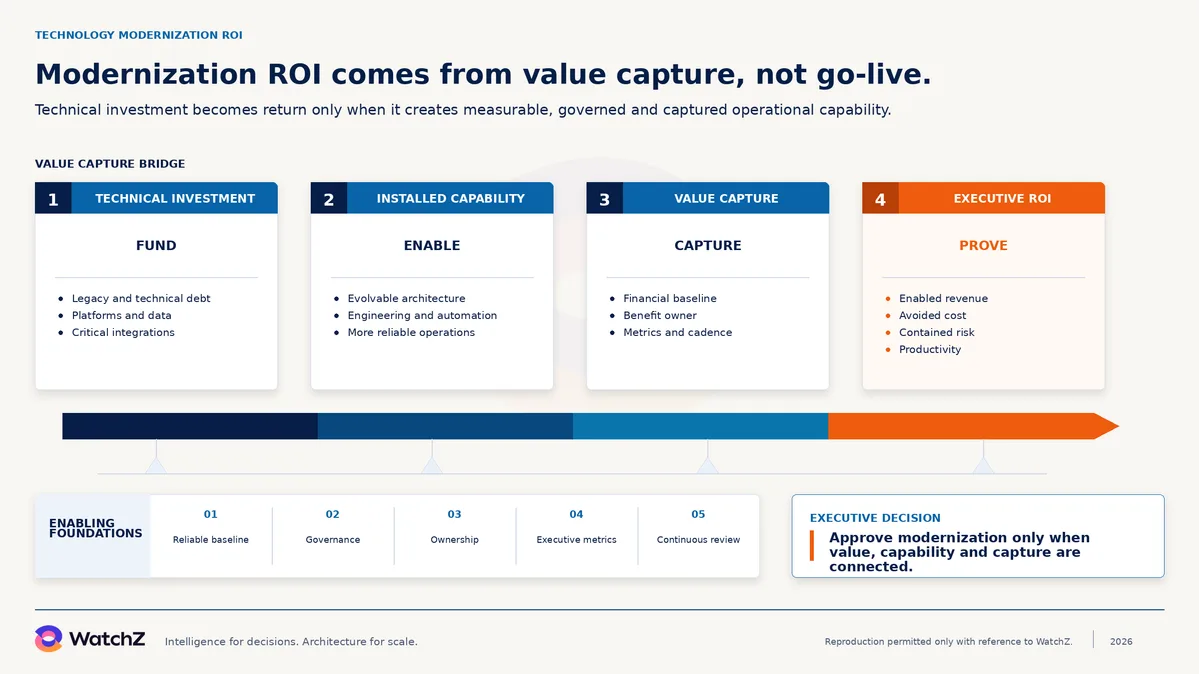
The thesis here is direct. Modernization ROI comes from the measurable removal of the frictions that limit revenue, raise cost, increase risk or slow execution, not from swapping platforms in itself. Modernizing matters. Capturing value is a different discipline, with an economic thesis before the spend, a baseline before the first change and an operating model that sustains the capture.
Three executive decisions before approving modernization
Before releasing capital, three decisions need to be made. They separate the program that proves return from the program that only swaps technology.
- Define, before the first investment, whether the return will be measured by enabled revenue, avoided cost, contained risk, time-to-market or operational productivity.
- Separate direct benefit, enabling benefit and avoided loss. Adding everything into the same mechanism creates double counting and weakens the board's confidence.
- Tie each initiative to a baseline, a benefit owner, a capture window and the operational decision needed for value to show up.
These three decisions are not a planning exercise. They are the line the CFO will collect on when the quarter closes.
The mistake is treating modernization as an IT project
The most common way to weaken the return is to frame modernization as an internal technology agenda. In that model, the business case talks about migration, rewrite, cloud, containers, platform, version upgrade or technical debt reduction. All of those moves can be relevant. None of them proves ROI on its own.
The board does not fund architecture for architecture's sake. It funds growth with control, preserved margin, reduced risk, operational productivity and the capacity to respond to the market. Technical language has to exist, but it stays subordinate to an economic logic.
A modernized application can reduce incidents, speed up changes, eliminate expensive licenses, cut dependency on specialists, unblock new channels, improve partner integration or reduce regulatory exposure. The return appears when the organization connects those effects to a line of value. Without that connection, modernization becomes a well-intentioned narrative.
Fix the baseline before the past disappears
The baseline is the snapshot of the original state, recorded before the program alters the environment and erases the reference. It is not project bureaucracy. After the first go-live, it gets hard to prove what was recurring cost, where there was rework, how long a change took, what the failure rate was or which risk was concentrated in a legacy system.
A useful baseline combines financial, operational and technical metrics. On the financial side come total cost of ownership, licenses, infrastructure, support, vendors, cost per transaction and cost per change. On the operational side come maintenance effort, rework, blocked backlog, partner onboarding time, response time for critical demands and dependency on key people. On the technical side come lead time, deploy frequency, failures, recovery, availability, critical incidents and observability capability.
Engineering flow and stability metrics ask for precision. The official DORA guide describes indicators such as change lead time, deployment frequency and failure recovery time, useful to observe delivery speed and stability. They are not financial ROI on their own. They are signals of capability that need to be connected to measurable economic impact.
Without a baseline, any later gain tends to become perception. With a baseline, the debate leaves the field of opinion and enters the field of evidence.
Separate direct return, enabling return and avoided loss
The most dangerous methodological mistake is treating every benefit as if it had the same nature. Modernization generates direct return, enabling return or avoided loss. Each category requires its own indicator, capture window and governance.
Direct return goes straight to cost
It is the benefit that shows up objectively in cost or in the operational flow. Shutting down an expensive platform, consolidating a tool, reducing infrastructure, eliminating a redundant contract, automation that cuts recurring rework or a drop in the unit cost of processing. This return tends to be easier to audit. It also tends to be smaller than the initial narrative promises when transition and parallel-operation costs are ignored.
Enabling return comes from capability, not from the delivery
It is the benefit that does not come straight from the technology, but from the capability it creates. A new integration backbone is not ROI on its own. The ROI shows up in faster partner launches, entry into a new channel, reduced onboarding time, improved conversion in a digital buying journey or the capacity to process data for a faster commercial decision. The enabler has to be connected to a business decision, not just to a technical delivery.
Avoided loss is modeled risk containment, not automatic efficiency
It is the benefit tied to risk containment. Obsolete systems concentrate cyber, regulatory, operational, reputational or continuity risk. Here the return should not be sold as automatic efficiency. It should be modeled as reduced exposure, avoided loss or continuity capability. The NIST Risk Management Framework reinforces the need for measurable and repeatable processes to manage security and privacy risk, and the NIST Cybersecurity Framework 2.0 positions risk as a matter of governance and executive communication.
Prioritize by capturable value, not political visibility
Modernization roadmaps face pressure from three forces. Systems with the most operational noise, areas with the most political power and legitimate technical preferences from architecture. None of them should be ignored. But the prioritization criterion has to be capturable value adjusted for risk, effort, dependency and time to capture.
The question is not just which system is oldest. The question is which intervention removes the biggest economic blockage with the lowest acceptable risk and the highest chance of capture. That distinction changes the order of the portfolio. A low-visibility component may come first because it unblocks billing, cuts recurring cost or eliminates a critical dependency. A technically important initiative may wait when it depends on data governance, process review, ownership change or an integration architecture that does not yet exist.
The strong portfolio sequences capability, risk and return in a defensible order. The most ambitious one is rarely the most defensible.
Take the board indicators the board can use
A recurring mistake is bringing an excess of technical metrics into an executive discussion. The board does not need to decide between Kubernetes, rewrite, asynchronous integration or version upgrade. It needs to decide whether the company is becoming more capable of growing, operating, protecting and changing with discipline.
Five blocks organize that conversation better. Revenue increase, cost reduction, risk compression, time-to-market acceleration and operational productivity. Technical indicators fit inside them, as long as they are translated into a business consequence. Shorter lead time matters when it speeds the launch cycle, cuts the cost of change or increases the capacity to respond. Higher availability matters when it protects revenue, experience or the fulfillment of an obligation. Fewer incidents matter when they reduce rework, exposure, operational loss or support cost.
That translation cannot become makeup. A benefit should appear once, in one block. If the same automation reduces rework, it cannot be counted at the same time as operational savings, productivity gain and margin increase without a separation mechanism. Double counting is the fastest path to losing executive credibility.
The operating model decides whether value gets captured
New technology inside an old operating model delivers less than it promises. Slow approvals, backlog disconnected from strategy, diffuse ownership, absence of product accountability, architecture without discipline and security inserted late in the delivery cycle create value leakage. The platform improves and the company keeps operating with the same friction.
That is why modernization ROI has to be governed as an enterprise performance program. Each front needs a benefit owner, a capture metric, a baseline, the operational decision required, the associated risk and a measurement window. The technology delivers the means. The operating model turns the means into a result.
In practice, that requires clear decision-making roles, value-based prioritization mechanisms, flow metrics, architecture discipline, security integrated into the cycle, data governance and FinOps capability when cloud is part of the equation. Without that set, the organization swaps the technical base and preserves the structural inefficiency.
Business case governance does not end at go-live
Programs tend to treat the business case as an approval document. That reading is fragile. The business case has to work as a contract for learning and capture. It should evolve when assumptions change, when dependencies appear, when transition costs rise or when the expected benefit does not materialize in the expected window.
Mature governance asks, in short cycles, four things. Whether the benefit still exists, whether the metric still measures what matters, whether the owner can still capture the value and whether the next initiative is still the best capital allocation. That discipline protects the company from two extremes. Insisting on a technically elegant roadmap with no visible return, or canceling a change too early when its cost rises before it falls because parallel environments are running.
Serious modernization lives with the transition curve. In a good share of cases, cost rises before it drops. There is coexistence, gradual migration, training, process change, additional observability, data management and security controls. That does not invalidate the ROI. It requires a realistic milestone, transparency and management of the capture curve.
Executive checklist to approve or review the program
- Is there a baseline of cost, time, failure, risk and productivity before the first change?
- Does each initiative have an explicit return mechanism, whether enabled revenue, avoided cost, contained risk, time-to-market or productivity?
- Was the direct benefit separated from the enabling benefit and the avoided loss?
- Is there a benefit-capture owner outside technology when the value depends on the business?
- Is the capture window realistic and does it account for transition and parallel-operation cost?
- Is the portfolio prioritized by capturable value adjusted for risk and dependency?
- Were the indicators translated into board language without erasing the technical evidence?
- Is there an explicit mechanism to avoid double counting?
- Does the operating model evolve together with architecture, data, security and engineering?
- Will the business case be reviewed during the program, not just used for initial approval?
Conclusion
For a good share of companies, modernizing is not an aesthetic choice. It is a condition to sustain growth, reduce risk, improve experience, speed the response to the market and preserve margin. The executive question is not whether modern technology is better. The question is whether the organization knows how to convert modernization into demonstrable value.
The right program starts with an economic thesis, fixes a baseline, separates the return mechanisms, prioritizes capturable value, translates indicators for the board and adjusts the operating model together with the technology. That is the turning point. Modernization stops being a sequence of technical deliveries and becomes a discipline of value capture.
When the company has to explain too much about why it is modernizing, the investment is probably not the problem. The problem is that value was not defined, measured and governed from day one. Modernization without an economic thesis at the start has no return to prove at the finish. It has a narrative.
Sources
- WatchZ. "How to measure the ROI of technology modernization". 29 May 2026. Base text for the revision and rewrite.
- DORA. "DORA's software delivery performance metrics". Reference used to delimit delivery flow and stability metrics, such as lead time, deployment frequency and failure recovery time.
- NIST. "Risk Management Framework" and "Cybersecurity Framework 2.0". References used to frame risk as a measurable, governable discipline that can be communicated to executive leadership.