


Every company says it wants to bring business and technology closer. Few design the mechanisms that make that proximity measurable, repeatable and governable. It is in that space between intent and mechanism that technology misalignment takes hold.
The problem rarely starts as a technical failure. It starts when strategy, governance, architecture, engineering, data, security and operations use different languages to defend legitimate decisions. The board talks about growth. The CFO asks for return. The COO pushes for efficiency. The CISO protects risk. Engineering talks about speed and stability. The data team asks for quality and ownership. Each area is partly right. The whole operates without a shared horizon of value.
Reducing technology misalignment requires redesigning the operating model, not scheduling one more alignment meeting. That model turns strategic intent into installed capability, prioritized decisions, coordinated execution and continuous learning.
Misalignment starts where executive translation is lost
Calling technology misalignment a communication failure is comfortable, but insufficient. Communication explains noise. It does not explain why the portfolio grows, priorities change every week, architecture accumulates exceptions, data does not support decisions and the return on investment stays hard to defend.
Misalignment appears when the company approves a business ambition without making explicit which capabilities need to evolve to sustain it. Grow in digital, gain scale, reduce operating cost or use AI are strategic directions. They are not, on their own, execution decisions. To become execution, they have to be translated into capabilities. Integration, data, security, observability, automation, architecture, governance, product engineering, operations and value metrics.
When that translation does not happen, technology becomes a queue. Each area asks for what it sees. Each team optimizes its own slice. Each priority looks urgent. The result is a crowded portfolio, a pressured operation and a weak executive narrative about return.
The first discipline is translating strategy into measurable capabilities
An executive should not fund a project without understanding which business or technology capability is being created, strengthened or protected. That is the first management shift. Investment stops being defended as scope delivery and starts being defended as capability evolution.
An expansion strategy may require scalable architecture, resilient integration, comparable data across units, security embedded in the delivery flow and an operation able to absorb demand variation. Without that map, the company funds isolated initiatives and expects the sum to produce capability. In practice, it often produces complexity.
The turning point is building a capability map with three simultaneous readings. Business impact, current maturity and the risk of not evolving. That reading changes the conversation. The debate moves from which project enters the roadmap to which constraint prevents the strategy from generating cash, margin, productivity or risk reduction.
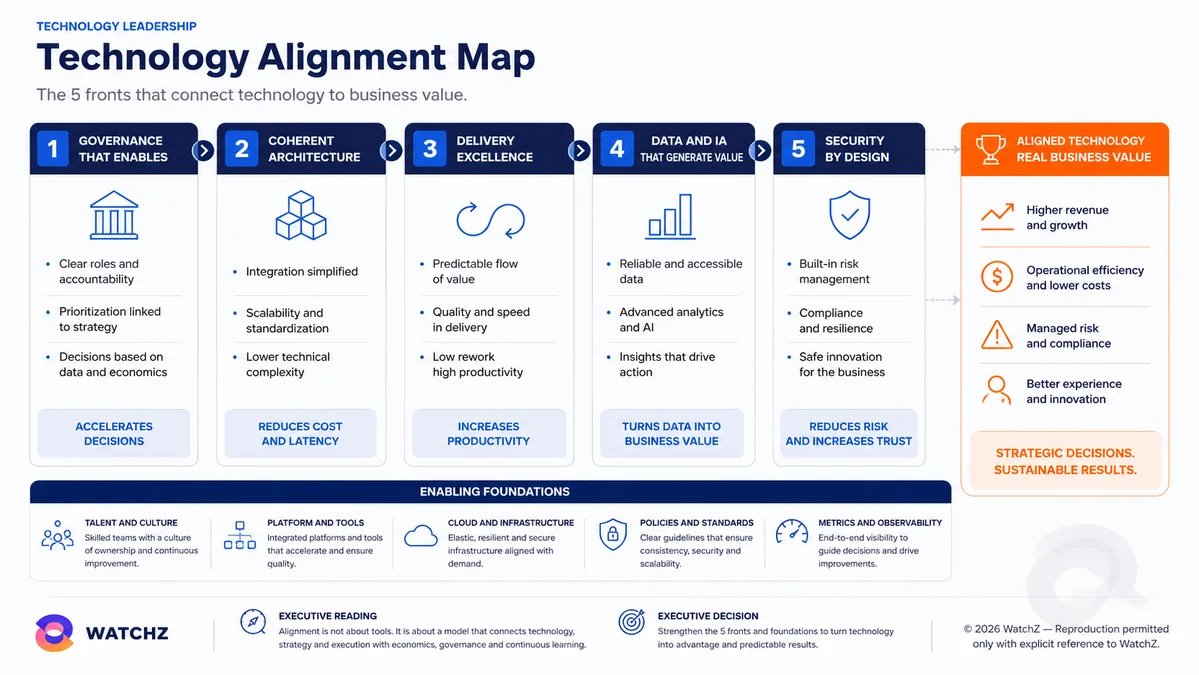
Mature governance speeds decisions. Immature governance creates control theater
Governance should not be confused with a committee, a form or a chain of approvals. Governance is the design of who decides, under which criterion, over which horizon, with which mandate and under which metric of consequence.
Weak governance allows permanent exceptions. Excessive governance turns decisions into bottlenecks. Mature governance does something harder. It creates clarity about trade-offs. When to accelerate, when to preserve stability, when to accept controlled risk, when to stop an initiative and when to invest in the foundation before promising growth.
That distinction matters because technology lives under permanent tension. Speed without control raises risk. Control without fluidity destroys time-to-market. Autonomy without architecture multiplies hidden cost. Centralization without context paralyzes execution. The right model does not pick an extreme. It makes explicit the criteria for deciding between them.
Architecture has to move from the approval seat to the coherence seat
Enterprise architecture and software architecture lose value when they become only late documentation or a veto body. The strategic role of architecture is to preserve coherence as the organization grows, diversifies channels, integrates systems, changes processes and increases dependencies.
That coherence has an economic implication. Unnecessary variability raises integration cost. Poorly managed dependency reduces autonomy. Data without a common model makes decisions harder. Legacy without a coexistence strategy becomes an emotional argument, not an economic decision.
The mature answer is not to replace everything. In many contexts, preserving, encapsulating, isolating, simplifying dependencies or creating an integration layer produces more value than a broad rewrite. The architectural decision has to weigh benefit, cost, risk, reversibility, operational impact and execution capacity. When that does not happen, the organization trades a strategic decision for a technical preference.
Engineering, data and security have to operate on the same value horizon
Engineering measured only by volume tends to accumulate structural debt. Security triggered late becomes a blocker. Data treated as a byproduct arrives too late to guide decisions. Misalignment materializes exactly in that design. Each discipline optimizes its own indicator and the system loses performance as a whole.
The company needs integrated goals. If a digital front is critical for growth, security enters the design from the start, data has defined ownership, engineering measures quality and predictability, operations takes part in the reliability design and the business makes the expected result explicit.
This does not mean turning every team into a permanent committee. It means creating clear operating contracts. Which decisions are local, which require architecture, which risks need executive sign-off, which data is critical and which metrics indicate that the delivery generated real value.
Alignment has to run in short cycles of evolution
A large annual transformation program tends to age before it captures all the promised value. Strategy changes, budget changes, competitive pressure changes, risk changes and the technology base changes. The way out is not improvisation. It is a short cadence of diagnosis, decision, execution and recalibration.
That cycle has to be light, but not superficial. Diagnosis without a decision becomes a report. A decision without an owner becomes an intention. Execution without a metric becomes activity. A metric without review becomes a decorative dashboard. The discipline is in closing the cycle and reviewing the portfolio based on evidence, not on political pressure.
Here indicators of flow, quality, reliability, risk, cost and result come in. Delivery metrics help understand operational capacity. Financial and business metrics help understand conversion into value. None of them solves it alone. The gain is in looking at the system, not at a single dimension.
Start with the decision, not with another heavy program
Start small, but start in the right place. The decision. Choose a relevant business front and map where strategy loses force on its way to execution. The goal is not to assemble an endless diagnosis. It is to reveal the constraints that keep the result from appearing.
In 30 days, identify the critical capabilities, the decision owners, the main governance bottlenecks, the architectural dependencies and the metrics that today cannot prove value. In 60 days, redesign the prioritization mechanism, make risk criteria explicit and define which initiatives need to continue, stop or change sequence. In 90 days, connect portfolio, architecture, engineering, data, security and operations in a cadence of evolution with an executive owner.
The gain is not in the ritual. It is in the change of decision pattern. The company stops asking only what will we deliver and starts asking which capability are we raising, which constraint are we removing and which result do we need to prove.
Leadership has to demand five commitments
- Every relevant initiative declares which capability it strengthens and which result it protects.
- Every critical decision has a named owner, an explicit criterion and a review horizon.
- Every technology investment is defensible in the language of margin, productivity, risk and time-to-market or customer experience.
- Every architecture makes dependencies, trade-offs and reversibility explicit.
- Every evolution cycle closes diagnosis, decision, execution and recalibration.
Conclusion
Technology misalignment does not disappear when business and technology talk more. It shrinks when the company changes the mechanism by which it decides, funds, executes and measures technology.
The thesis is simple and hard. As long as technology is treated as a queue of projects, the return will stay contested. When technology starts being managed as a system of capabilities connected to results, the conversation moves from cost to value, from urgency to sequence and from opinion to an executive decision under control.
The company that learns this discipline does not eliminate conflict. It turns conflict into an explicit trade-off. That is the difference between a busy technology and a technology that moves results.
Sources
- WatchZ. "How to reduce technology misalignment". Published May 28, 2026. https://watchz.io/pt-br/insights/como-reduzir-desalinhamento-tecnologico
- DORA. "DORA metrics". Research program maintained by Google Cloud on software delivery and operations performance metrics and capabilities. https://dora.dev/guides/dora-metrics/
- ISO. "ISO/IEC 38500:2015, Information technology, Governance of IT for the organization". https://www.iso.org/standard/62816.html
- ISACA. "COBIT". Framework for the governance and management of enterprise information and technology. https://www.isaca.org/resources/cobit
- IEEE. "ISO/IEC/IEEE 42010:2011". Standard for the architecture description of systems and software. https://standards.ieee.org/standard/42010-2011.html