


When a decision on architecture, risk or investment takes weeks to clear, the instinct is to touch the agenda. One more committee. A new cadence. A forum with a new name. The surface looks tidier and the decision stays put.
The problem is rarely the number of meetings. The cause lives in the design of the decision system. Ambiguous power, diffuse accountability and information too thin to decide with confidence. Until that structure changes, each new forum only moves the bottleneck somewhere else.
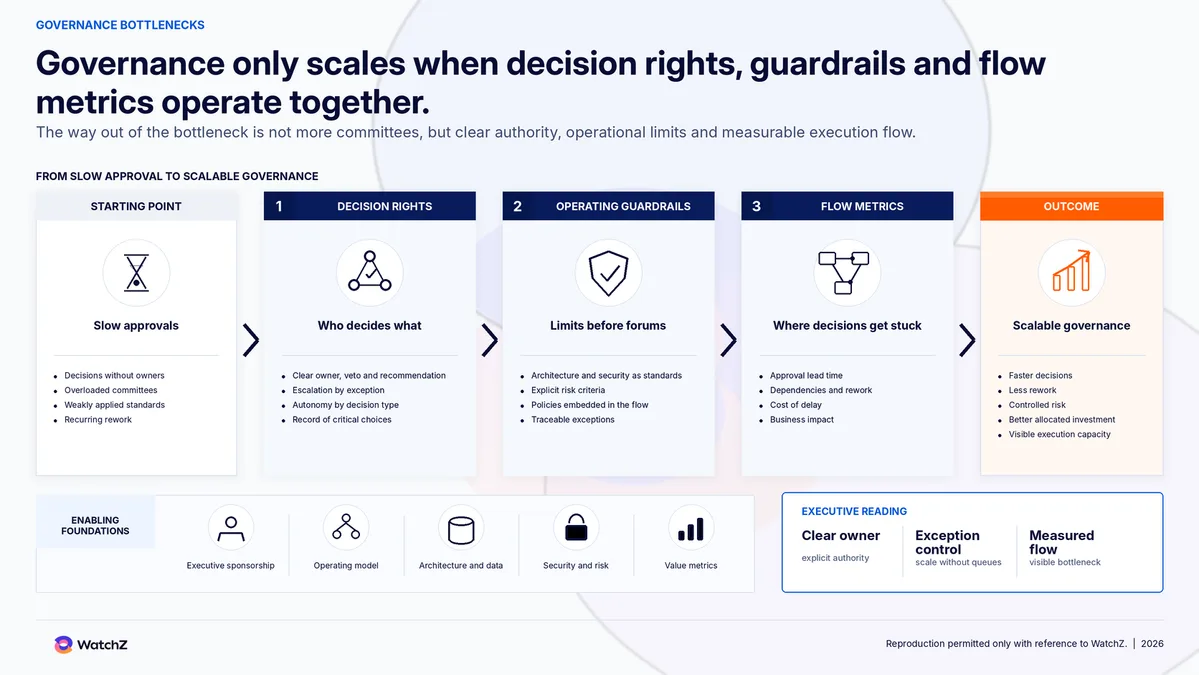
Fixing it follows four moves. Separate decisions by layer, make explicit who decides each one, swap case-by-case approval for guardrails, and instrument the flow. The order matters, and the reason changing the ritual so often leaves the decision blocked comes last.
Slow governance is a result problem, not an agenda problem
When a decision on architecture, risk, data, investment or prioritization takes weeks to move, the most common reaction is to create another committee, change the cadence or rename the forum. That organizes the surface. It does not fix the cause.
The cause usually sits in the design of the decision system. The company does not know with precision which topics should rise, who has the authority to decide, who can veto, which decisions already fit inside approved guardrails and what minimum information sustains a defensible decision.
This is a result problem. Slow governance postpones revenue, raises opportunity cost, expands rework and keeps legacy dependency alive. The right question is not how to create more control. It is how to design enough control for relevant decisions to move with speed and responsibility.
Four patterns turn governance into a waiting line
The first pattern is decision concentration. Executive committees review topics that domain, architecture, security, product or operations leaders should resolve. Senior leadership stops directing and starts operating as an approval line.
The second is role ambiguity. Many areas participate, advise and follow along, but nobody holds full accountability for the result. When everyone has blocking power and few have clear authority to decide, the process becomes a circuit of successive alignments.
The third is applying the same rigor to decisions of different impact. A reversible, low-risk adjustment travels the same path as a regulatory change or an architecture decision with long-term effect. The model looks prudent and consumes executive energy where risk does not justify it.
The fourth is poor input quality. Forums receive topics without criteria, without trade-off analysis, without an executive recommendation and without comparable data. Nobody approves in the dark. The decision returns for re-analysis, and governance reopens the debate instead of closing it.
The decision needs a layer, an owner and a limit
Fixing governance bottlenecks starts by separating decisions by nature. Strategic decisions define direction, investment, risk appetite and structural trade-offs. Tactical decisions translate that direction into priority, sequencing and execution criteria. Operational decisions resolve implementation within the limits already approved.
That separation changes the design of power. Board and executive leadership concentrate energy on irreversible choices, on the highest-impact bets and on the risks that affect cash, margin, reputation or continuity. Domain leaders decide what sits within their remit. Execution teams operate without asking permission for every predictable move.
COBIT, from ISACA, separates governing technology from managing it and organizes governance into the objectives of evaluate, direct and monitor. When the top takes over management, the two roles blur and the decision jams. The question that exposes the bottleneck is simple. For each type of decision, who has the final word? When the answer depends on political interpretation, the organization has already designed its own slowness.
Explicit decision rights reduce political friction
Responsibility matrices help, but they are not enough when they leave the decision implicit. Participating is not deciding. Following along is not vetoing. Recommending is not taking accountability. Validating is not always having the final word.
A robust decision model makes explicit who decides, who recommends, who holds technical or regulatory veto, who needs to be consulted, who executes and when escalation is mandatory. That clarity moves the discussion from personal territory to institutional design, and the conflict drops with it.
It also reduces the dependence on seniority to unblock recurring topics. When every exception rises to the same group of executives, the problem is not volume. It is a lack of delegation with clear limits.
Guardrails replace case-by-case approval
Mature governance does not review each decision individually. It creates limits so that most decisions happen without escalation. Architecture standards, minimum security criteria, investment bands, data policies, compliance requirements, criticality levels and conditions for exception.
The balance point is critical. A guardrail that is too rigid recreates the slowness it should eliminate. A guardrail that is too vague increases rework and exposure. The calibration depends on the organization's maturity, on asset criticality, on how regulated the sector is and on how reversible the decision is. The AWS Well-Architected Framework recommends separating reversible decisions from irreversible ones and delegating the reversible ones closer to execution when it makes sense. It is the rule that removes the line without loosening rigor where it matters.
The executive difference is in the focus. The governance effort concentrates on decisions whose financial, operational, regulatory or reputational impact justifies additional validation. The rest flows within limits already accepted.
Without metrics, governance becomes political perception
Companies measure delivery, deadline, backlog, availability and cost. Few measure the flow that precedes delivery. When the decision is the bottleneck, that absence of measurement creates a structural blindness.
Leadership should track average time to decide by type, escalation rate, re-analysis volume, share of topics approved with incomplete information, idle time between forums and the impact of delayed decisions on priority programs.
These indicators show where governance fails. In some cases, the problem is in the forum. In others, in the quality of the input material. In others, in the excess of interdependency between areas. Without data, the conversation becomes a dispute over perception. With data, it becomes a diagnosis of flow and capability.
The correction starts with the map of critical decisions
The first move is to map the critical decisions. Not all of them. Only the ones that affect investment, risk, architecture, customer experience, margin, revenue, operational continuity or relevant technology dependency. A structured capability diagnosis fixes that map before any forum redesign.
The second is to classify those decisions by layer. What is strategic, tactical and operational. What is reversible and irreversible. What requires expanded traceability. What can be delegated safely.
The third is to assign explicit decision rights. Each decision needs an owner, an entry criterion, an escalation condition and a clear record of outcome, owner and deadline.
The fourth is to instrument the flow. When the organization does not measure where the decision stalls, it keeps correcting symptoms. Changing the meeting without changing power, information and accountability only moves the bottleneck. That is why the correction is a capability evolution, not an isolated process adjustment.
Conclusion
The governance that creates value is not the heaviest. It is the one that puts each decision at the right level, with the right information and a degree of control proportional to risk. It protects the company without turning every choice into an executive escalation.
For senior leadership, the question that matters is not how to have more governance. It is how to have the right governance, so that technology, risk and execution contribute directly to results.
When an organization decides too much and advances too little, the next step is not to schedule another committee. It is to redesign the decision system so that control and speed stop competing. The next decision that stalls for weeks is the test. Either the authority is in the design, or it stays in the line.
Sources
- ISACA. COBIT 2019. Reinforces the distinction between governance and management of information and technology, organizing governance objectives in the evaluate, direct and monitor domain.
- Bain & Company. RAPID model to clarify decision roles, recommend, agree, perform, provide input and decide.
- AWS Well-Architected Framework. Recommends differentiating reversible from irreversible decisions, delegating reversible ones to levels closer to execution when appropriate.
- These references do not replace the company's contextual design. They support the logic that effective governance depends on decision rights, escalation criteria and proportionality of control.