


Integration usually reaches the board after a failure. An acquisition that takes too long to absorb. A new channel that misses its launch date. A financial close stuck in manual reconciliation. An audit that cannot reconstruct the transaction end to end. By that point the problem has stopped being middleware. It affects schedule, margin, risk and the capacity to change.
The question that arrives with it is always the same. How to measure enterprise integration ROI when the benefit spreads across several functions and none of them recorded the starting point.
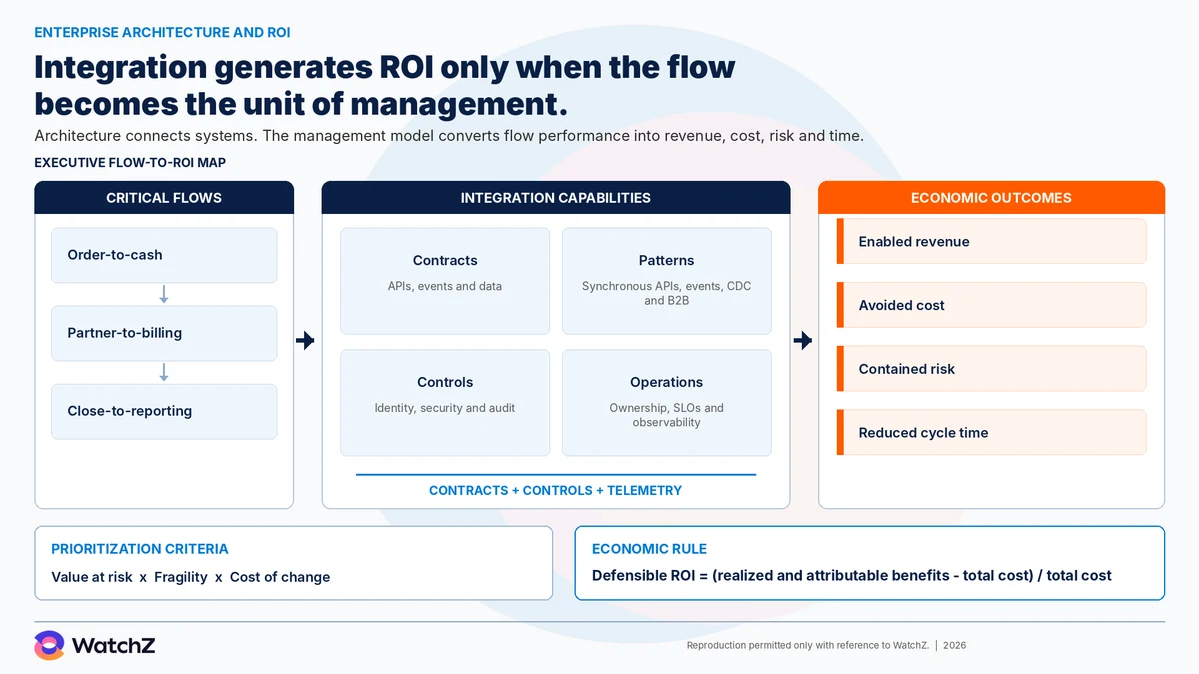
Integration does not generate return because a company published more APIs, bought an iPaaS or replaced a bus. It generates return when critical business flows start operating with clear contracts, defined ownership, controls proportional to risk, end-to-end observability and attributable economic metrics.
That changes the unit of management. The asset is no longer the isolated interface. It becomes the flow that crosses systems, functions and partners to produce a business outcome.
The invisible cost of integration is the cost of changing it
The visible cost of fragile integration shows up in incidents, rework, on-call load, reconciliation and interface maintenance. The strategic cost shows up when a simple change requires excessive coordination, broad regression testing or negotiation across several teams. That cost of change is what turns a local decision into a portfolio constraint.
The relationship is not universal. Opportunity cost will not always exceed operating cost. In flows with high criticality, high volatility or strong external dependency, however, delay can affect revenue, customer experience, working capital or regulatory exposure. The mature decision is to measure both costs per flow instead of assuming which one dominates.
A direct connection can be rational when it is isolated, stable, reversible and low risk. The problem starts when local connections multiply without contract, owner, inventory or change policy. In that scenario the company is not only accumulating integrations. It is accumulating dependencies nobody can price.
The business flow should be the unit of analysis
A flow is a sequence of events, decisions and information transfers that produces an observable outcome. Order to receipt, partner to invoice, close to report, claim to payment. Each flow crosses different systems, yet it has an economic outcome and a business owner that can be made explicit.
Managing integration by flow avoids two errors. The first is optimizing an endpoint while the transaction keeps failing at another step. The second is attributing return to a platform without demonstrating which cycle, cost or risk actually changed.
For each priority flow, the organization needs to know:
- expected outcome and business owner;
- systems, partners and data involved;
- required criticality, volume, latency and consistency;
- failure points, manual intervention and dependencies;
- technical and business service levels;
- operational and economic baseline before the intervention.
Without that framing, architecture tends to be decided by technical preference or vendor catalog. With it, technology answers to the dominant constraint of the flow.
The architectural choice is a portfolio decision
Point-to-point, ESB and iPaaS do not form a complete taxonomy, nor are they mutually exclusive alternatives. ESB describes a centralized integration pattern in which a dedicated component performs routing and transformation. iPaaS describes a category of managed platform for connecting applications, systems and data. An organization can use both while also operating APIs, events, messaging, CDC and B2B integrations.
Event-driven architectures decouple producers and consumers through event channels. They are useful when multiple consumers need to react to changes, when processing can be asynchronous or when the organization needs to absorb load variation. That decoupling brings new responsibilities. Idempotency, ordering, duplicate handling, observability and eventual consistency become requirements rather than implementation details.
Synchronous APIs fit when the consumer needs an immediate response and the availability contract can be sustained. Messaging helps when load must be buffered, availability decoupled or processing guaranteed. Orchestration is appropriate when step sequence, compensations and process state need to be explicit. CDC records data changes for incremental consumption and supports synchronization and analytical pipelines, without replacing the semantics of a business process on its own.
The question that settles the design is not which technology is more modern. It is which combination minimizes risk and total cost without compromising the outcome of the flow. Hybrid architecture is not a sign of failure. It becomes a problem when coexistence lacks principles, contracts, ownership and retirement criteria. Architectural capability is what sustains that coexistence without turning it into accumulation.
Contracts should be treated as products
APIs as products is a useful principle, but a narrow one if applied only to HTTP. The organization also needs to treat events, schemas, topics, datasets, B2B files and reusable components as integration contracts.
The OpenAPI Specification offers a standardized, language-independent description for HTTP APIs. AsyncAPI treats the interface document as a communication contract between senders and receivers in event-driven systems. These standards improve discoverability and clarity without replacing product, security or operating decisions.
A governed contract should make explicit:
- owner, purpose and known consumers;
- semantics, schema and compatibility policy;
- versioning, deprecation and transition window;
- data classification and access controls;
- SLOs, consumption limits and failure behavior;
- minimum telemetry and operating cost;
- retirement or replacement criteria.
Product discipline removes the need for every consumer to negotiate how the interface works from scratch. The economic gain comes from reliable reuse and reduced cost of change, not from documentation alone. Well-designed internal engineering platforms make that standard reusable instead of merely recommended.
Governance and security should follow the risk of the flow
Late security does not necessarily produce a fine or an incident. It raises the probability of rework, exceptions and exposure. NIST recommends identifying risks and applying controls during API development and runtime stages, with an incremental, risk-based approach. OWASP highlights, among other points, broken authorization, authentication failures, unrestricted resource consumption, sensitive business flow exposure, misconfiguration, inventory gaps and unsafe consumption of third-party APIs.
Integration design has to account for machine and user identity, object-level and function-level authorization, secrets management, encryption, schema and payload validation, quotas, replay protection, audit trail, version inventory and controls over external dependencies.
Control intensity should be proportional to criticality. A financial flow exposed to partners requires different treatment from a reversible internal automation. Standardization without proportionality becomes bureaucracy. Autonomy without controls becomes accumulated risk. Security as a capability embedded in architecture is what keeps both ends under control.
Risk. Centralizing every decision in a single team may simply replace technical coupling with an organizational queue. Reusable guardrails and distributed responsibility scale better than permanent manual approval.
Observability should reconstruct the transaction, not just the endpoint
Availability, latency and error rate for an API are necessary and insufficient signals. A flow can fail after a technically successful response, sit idle in a queue, duplicate an operation or require manual intervention without raising an alert.
Context propagation makes it possible to correlate traces, metrics and logs across distributed services. That allows the causal chain of a request to be reconstructed across process and network boundaries. In asynchronous architectures, correlation requires additional conventions for messages, events and business identifiers.
Mature metric governance operates at three levels:
- technical: availability, error, latency, backlog, lag, retry and consumption;
- flow: end-to-end success rate, cycle time, abandonment, duplication and manual intervention;
- economic: revenue at risk, cost per transaction, cost avoided, onboarding time, immobilized capital and residual exposure.
The board does not need to track every technical metric. It needs a small set of aggregated indicators showing whether the flow is delivering the outcome, which risk remains and where capacity is limiting growth.
Measuring enterprise integration ROI requires baseline, total cost and attribution
The ROI calculation starts before implementation. Without a baseline, benefit will be attributed by narrative. Without total cost, the platform will look cheaper than it is. Without an attribution rule, enabled revenue can be counted by several initiatives at once.
The minimum model considers benefits and costs across the lifecycle.
Possible benefits:
- revenue enabled by a new channel, product or partner;
- revenue protected by fewer billing failures or less downtime;
- cost avoided through automation, less rework and lower support effort;
- reduced cycle time, with effect on working capital or operating capacity;
- reduced expected loss, calculated as the difference between probability and impact before and after controls.
Total cost:
- licenses, consumption and connectors;
- engineering, migration, testing and coexistence;
- security, observability and operation;
- training, change management and support;
- legacy decommissioning, vendor exit and residual debt.
The formula is simple. The rigor sits in the numerator.
ROI = (realized and attributable benefits - total cost) / total cost
Enabled benefit is the value the architecture made possible. Influenced benefit is the value integration contributed to. Realized benefit is the value that actually occurred. Attributable benefit is the share that can be defended as a consequence of the intervention. For a conservative calculation, only realized and attributable benefits belong in the numerator.
That discipline has precedent in public funding. The U.S. Technology Modernization Fund prioritizes high-impact initiatives with measurable return and releases money incrementally by milestone, conditioning each tranche on the evidence produced by the previous one. The same logic works inside a corporate portfolio. The continuation criterion matches the one used for measuring the ROI of technology modernization, applied to the flow instead of the system.
Prioritizing integration means choosing where value is most exposed
Inventory is necessary and insufficient. An interface catalog that does not connect dependencies to flows, owners and economic impact only digitizes the disorder.
Prioritization combines three dimensions. Value at risk, current fragility and cost of change. From that reading, the portfolio splits into four decisions:
- stabilize now: critical, fragile, high-impact flow;
- industrialize: relevant, recurring flow that justifies contracts, automation and shared capability;
- simplify or retire: expensive or redundant integration, or one without a relevant consumer;
- tolerate and monitor: stable, low-risk connection whose cost of change exceeds the benefit.
That classification avoids two traps. Modernizing everything and standardizing everything. The objective is economic coherence, measured flow by flow.
Modernization should be incremental and conditioned on results
In legacy environments, full replacement concentrates risk. The strangler fig pattern is the reference for migrating capabilities gradually, maintaining coexistence while functionality moves to the new solution. The reference documentation for the pattern also records its limits, including the potential for the proxy layer to become a bottleneck or single point of failure.
An executable sequence for enterprise integration is:
- discover integrations and reconstruct the priority flows;
- establish a technical, operational and economic baseline;
- select patterns and contracts according to the constraint of the flow;
- embed controls and telemetry before migration;
- migrate in reversible slices and measure the result;
- decommission components only when consumers and risks have been handled;
- reallocate investment based on realized benefit and released capacity.
Reference architecture provides consistency. The operating model guarantees ownership. Portfolio management decides where capability generates the most return. Without all three, incremental legacy modernization swaps technology and preserves the same cost of change.
What CIO, CFO and COO need to decide together
Integration with ROI is not a technology-only program. The CIO answers for architecture, capability and technical risk. The CFO enforces discipline on baseline, attribution, total cost and benefit recognition. The COO and business owners validate the flow, the operational impact and adoption.
The executive agenda has to answer five questions:
- which flows concentrate value, risk or cost of change;
- which constraint dominates each flow;
- which architectural combination is adequate and reversible;
- which benefits can be measured and attributed;
- which evidence authorizes scaling, correcting or stopping the investment.
When those questions go unanswered, the organization buys technical capability without a value capture mechanism. When they are answered, integration stops being a ticket queue and becomes a portfolio instrument.
Conclusion
Integration does not produce ROI by existing. APIs, events, buses and platforms are mechanisms. Return appears when the company selects the pattern according to the constraint of the flow, governs contracts as products, embeds security proportional to risk, observes the transaction end to end and measures realized benefits against total cost.
The most important change is managerial. Moving from counting interfaces to managing flows as economic assets. That discipline lowers the cost of change, makes risk visible and directs investment to where architecture actually alters the result. A capability assessment identifies which flows concentrate exposed value before the next platform decision.
The platform connects systems. The management model connects architecture to value.
Sources
- Microsoft Azure Architecture Center. "Event-driven architecture style". https://learn.microsoft.com/en-us/azure/architecture/guide/architecture-styles/event-driven
- IBM. "What Is an Enterprise Service Bus (ESB)?". https://www.ibm.com/think/topics/esb
- IBM. "What Is iPaaS (Integration Platform as a Service)?". https://www.ibm.com/think/topics/ipaas
- OpenAPI Initiative. "OpenAPI Specification v3.2.0". https://spec.openapis.org/oas/v3.2.0.html
- AsyncAPI Initiative. "AsyncAPI document, communication contract for event-driven systems". https://www.asyncapi.com/docs/concepts/asyncapi-document
- NIST. "SP 800-228, Guidelines for API Protection for Cloud-Native Systems, update 1". https://csrc.nist.gov/pubs/sp/800/228/upd1/final
- OWASP. "OWASP API Security Top 10, 2023". https://owasp.org/API-Security/editions/2023/en/0x11-t10/
- OpenTelemetry. "Context propagation". https://opentelemetry.io/docs/concepts/context-propagation/
- AWS Prescriptive Guidance. "Strangler fig pattern". https://docs.aws.amazon.com/prescriptive-guidance/latest/cloud-design-patterns/strangler-fig.html
- U.S. Technology Modernization Fund. "About the TMF, measurable return on investment and incremental funding". https://tmf.cio.gov/about/
- Microsoft Learn. "Change Data Capture (CDC) with Azure SQL Database". https://learn.microsoft.com/en-us/azure/azure-sql/database/change-data-capture-overview
- WatchZ. "Enterprise integration only delivers ROI when the flow becomes the unit of management". Revised editorial edition, July 2026.