


Enterprise architecture creates value when it is connected to decisions before priorities, vendors, platforms and financial commitments become hard to reverse, without needing to control every technology investment.
When it takes part only in the technical validation of already approved initiatives, its capacity for influence stays limited. It still reduces some risks, corrects inconsistencies and guides standards, but it rarely changes the structural choices that will determine cost, speed and flexibility in the following years.
The problem, therefore, lies less in the quality of the diagrams, frameworks or professionals, and more in the design of the decision system. In some organizations, strategy, portfolio, architecture, engineering, data, security and finance operate in different cycles. The business approves an initiative. The vendor is chosen. The budget is committed. Only after that is architecture called in to assess integrations, platforms, data and controls. By then, the most relevant decisions have already been made.
Enterprise architecture creates more value when it turns technology dependencies into useful information for the business decision. Its role does not replace executives, product owners or portfolio managers. It shows, while alternatives still exist, which choices expand capability, which create dependency and which transfer cost and risk to the future.
Three principles sustain architecture in practice
Architecture needs to influence before the commitment, not only review after it. This does not require veto power or a formal vote in every forum. It requires access, mandate and clear mechanisms so that risks, dependencies and alternatives are considered before approval.
The value of the function shows up in better decisions, not in artifact volume. Published standards, meetings held and diagrams produced demonstrate activity. Value appears when better decisions reduce redundancy, rework, fragility, integration time and difficulty of change.
Enterprise architecture makes trade-offs explicit, instead of eliminating them. Speed, autonomy, security, cost, resilience and standardization keep competing with one another. A mature architecture improves the quality of these choices and reduces contradictory decisions across areas.
Decision coherence is the real bottleneck, not the lack of architecture
A company can have competent architects, up-to-date repositories and technically sound standards and still keep accumulating complexity. This happens when each initiative is evaluated in isolation.
One business unit chooses a new platform to solve a local need. Another team hires a similar solution. A third area builds a specific integration to meet an urgency. Individually, each decision looks justifiable. Together, they expand redundancy, recurring cost, vendor dependency and difficulty of evolution.
Enterprise architecture exists to make this systemic effect visible. It connects the local decision to the capabilities the company needs to sustain, the assets it already owns, regulatory constraints, the data strategy, security standards and real operational capacity. This does not centralize every choice. It prevents relevant decisions from being made without understanding their structural consequences.
Position architecture before the alternatives disappear
The first test does not check whether an architecture committee exists. It identifies at which moment the function enters the decision cycle. When architecture is called in only after the business case is approved, its room to act narrows to technical detailing. It can still improve the design, but has little capacity to question premises such as the need for a new platform, the reuse of existing capabilities, the impact on master data, the future cost of integration, vendor dependency, regulatory exposure and the capacity for teams to sustain it.
Early participation does not turn architecture into a mandatory bureaucratic step for any initiative. The level of involvement must be proportional to the materiality of the decision. Low-impact and easily reversible investments operate within predefined guardrails. Decisions with high financial commitment, cross-cutting dependencies, regulatory implications or low reversibility require deeper analysis. Architecture influences the decision according to the risk and relevance of the choice, not out of a desire to control the whole portfolio.
Architectural influence qualifies the decision without owning it
Enterprise architecture does not replace strategy, finance, product or portfolio management. Each function has a distinct responsibility. The business defines outcomes and priorities. Finance assesses feasibility and economic constraints. The portfolio organizes investments and capacity. Product defines problems, outcomes and evolution. Architecture makes dependencies, alternatives and structural consequences explicit. Engineering validates feasibility and turns decisions into execution. Security and risk define controls proportional to exposure.
The governance design can include permanent participation, mandatory consultation, binding criteria or materiality-based assessments. No single model serves every organization. The indispensable requirement is that the architectural contribution arrives before the irreversible commitment, without making architecture the owner of every decision.
Define mandate, scope and metrics before publishing standards
An architecture function without a clear mandate swings between two extremes. In the first, it tries to control too many decisions and turns governance into an approval queue. In the second, it produces recommendations without authority, consequence or integration with the execution process.
The mandate needs to answer objective questions. Which decisions require architectural participation. Which decisions teams make autonomously. Which principles are mandatory. Where exceptions are acceptable and who takes on the risk of them. How standards are reviewed or discontinued. How conflicts between domains are resolved. How architecture connects to the portfolio and quarterly planning.
The formalization needed depends on context. Regulated companies, with multiple units, international operations or extensive legacy, tend to require more discipline. Smaller organizations, with a concentrated portfolio and low complexity, operate with lighter mechanisms. The goal is to adopt enough governance to reduce contradictory decisions without blocking the capacity to execute, not to maximize governance.
Metrics should reveal contribution, not create false attribution
Architecture rarely produces financial results in isolation. Its effects depend on product, engineering, operations, finance, security, data and leadership. That is why measuring architecture requires a discipline of contribution, not an artificial attempt to attribute every result to the function. Indicators can be organized in three levels.
Activity indicators show whether the function is operating: decisions recorded, initiatives assessed, exceptions open, standards reviewed and capabilities mapped. They are useful for internal management and insufficient to demonstrate value.
Operational indicators show changes in the conditions of execution: reduced time to integrate systems, increased reuse of platforms and components, fewer redundant applications, a lower volume of recurring exceptions, less rework from incompatible decisions and more predictability in cross-cutting changes. These indicators come closer to the real contribution of architecture.
Outcome indicators show broader enterprise effects: reduced recurring cost, lower operational exposure, better time-to-market, greater capacity to absorb acquisitions, new products or regulatory changes, and more reliability in executing strategic priorities. These results should not be automatically attributed to architecture, and the measurement must demonstrate the contribution mechanism, the baseline, the other initiatives involved and the limits of the method.
Turn architecture into a decision system
Enterprise architecture is worth more than a snapshot of the current environment or an idealized representation of the future. Its value lies in connecting four elements. The capabilities the business needs to strengthen, the technology constraints that block evolution, the necessary structural decisions and the viable sequence of transition.
The starting point is to understand where strategy meets real execution limits, not to choose a tool or a framework. This requires answering which capabilities are critical for growth, efficiency or risk reduction. Which platforms, data, integrations or processes limit those capabilities. Which decisions can be deferred and which become more expensive over time. Which changes create short-term value without compromising the structural direction. From these answers, architecture stops being an inventory and starts guiding decisions.
The feasibility of the sequence matters more than the design of the destination
Future visions set direction, but they do not change operations on their own. Between the current environment and the desired state lie budget constraints, transition risks, systems that still create value, contracts, capacity limits and competing priorities.
An executable architecture works with transition states. Instead of proposing a complete and distant replacement, it identifies moves that reduce critical dependencies, prepare reusable capabilities, remove selected redundancies, reduce risk before major changes and deliver observable results along the way. The quality of architecture appears both in the coherence of the destination and in the feasibility of the sequence.
Prioritize by the combination of value, risk and feasibility
Architecture should not turn every technical fragility into a business priority. There are architectural debts that constrain revenue, raise cost, expand regulatory exposure or block strategic execution. Others are tolerable imperfections, whose fix cost may exceed the benefit. The role of architecture is to distinguish these situations.
A defensible prioritization considers, at least, the impact on critical capabilities, the cost of keeping the current condition, the operational or regulatory risk, the difficulty of future change, the dependencies released, the effort available, the reversibility of the decision and the expected horizon for capturing the benefit. Prioritization by economic criteria organizes this reading.
This model reduces two frequent distortions. The first modernizes because technology looks old, even when it remains adequate to the economic and operational context. The second delays structural changes because their benefits do not fit inside the business case of a single initiative. Enterprise architecture helps recognize when a decision crosses the boundaries of a project and needs to be treated as capability evolution.
Orchestrate the disciplines without hovering above them
Enterprise architecture creates value when it connects business decisions to data, security, platforms, software, infrastructure, integration and operations, instead of acting as a layer distant from the technical specialties.
Data sustains processes, automation, artificial intelligence, controls and operational decisions, far beyond raw material for analytics. Architecture needs to make explicit ownership, shared definitions, critical flows, dependencies, quality requirements and limits of use and access. Without that coherence, each solution works locally while the organization loses the capacity to operate in an integrated way.
Security embedded in the design reduces late reviews, rework and unnecessary exposure. This does not eliminate the trade-off between speed, cost and protection. It makes the trade-off explicit and lets controls be proportional to risk. Identity, segregation, traceability and data protection need to enter the shaping of the solution, aligned with references such as the NIST Secure Software Development Framework, and not only before going into production.
Adopting AI expands the need for architectural decisions about data, integration, identity, observability, oversight, vendors and responsibilities. Without those capabilities, experiments stay disconnected from core processes or advance without controls compatible with the risk. Architecture does not guarantee that an AI initiative creates value. It creates the conditions to assess dependencies, avoid duplication and operate solutions with more consistency, in line with what the NIST AI Risk Management Framework organizes as risk governance across the life cycle.
Engineering is one of the main reality tests of architecture. Guidelines need to be implementable, understandable and compatible with the teams' capacity. When standards systematically increase effort without reducing risk, cost or complexity in another dimension, they need to be revised. The criterion is the demonstrable systemic benefit, not local convenience.
A stable base can expand autonomy
Autonomy is the capacity to make local decisions without continuously reopening structural questions, not the absence of constraints. Preferred platforms, integration principles, data policies, ownership models and security requirements create a common base. When that base is clear and up to date, a significant share of decisions no longer depends on individual approval.
The balance requires three mechanisms. Understandable guardrails to guide recurring decisions. A proportional exception process to handle legitimate situations without normalizing deviations. A feedback loop to review standards that no longer serve strategy or execution. Guardrails need to evolve with context, instead of crystallizing old choices. Autonomy becomes more efficient when teams know what stays stable, where they can decide and how to contest a rule that has lost validity.
Why enterprise architecture functions fail
Failure rarely has a single cause. Organizational problems are frequent: lack of sponsorship, late participation, ambiguous mandate, conflicting decision rights, local incentives, project-only funding and little connection to portfolio and planning. Technical factors also matter: incomplete models, outdated repositories, standards disconnected from reality, decisions without context and no criteria for evolution and exception.
There are also execution failures: target states without transition, recommendations without an owner, decisions without funding, dependencies that never reach the backlog, metrics without a baseline and benefits without follow-up. A well-positioned function can fail if its analysis is weak. A technically excellent function can fail if it does not take part in the relevant decisions. Mature enterprise architecture depends on the combination of positioning, technical competence, governance and capacity for change.
When a lighter architecture is enough
Not every company needs a formal, centralized or extensive enterprise architecture structure. Organizations with low business diversity, few platforms, a simple regulatory environment and easily reversible decisions operate with lighter mechanisms. In those contexts, architecture works as shared principles, federated technical leadership, decision records, temporary forums for higher-impact choices and guardrails maintained by the teams themselves.
The need for formalization grows with complexity, interdependence, irreversibility, regulation, scale, fragmentation, portfolio diversity and the cost of change. The right design is the smallest governance system able to preserve coherence without needlessly reducing speed, not the most sophisticated.
The executive test of enterprise architecture
The value test is not reduced to a single question about voting or budget control. The assessment needs to observe the complete system. Architecture takes part before the relevant commitments. Its analyses change or qualify decisions. Teams receive implementable directions. Exceptions generate learning. Decisions reduce redundancy or risk. The portfolio considers structural dependencies. Target states become fundable transitions. Indicators show changes in the conditions of execution.
Enterprise architecture exists to make structural choices more conscious, comparable and coherent with strategy, not to produce certainty where trade-offs exist. When it works, the company does not eliminate all complexity. It starts to distinguish necessary complexity from the complexity created by disconnected decisions. And that distinction improves investment, execution and the capacity for change.
Conclusion
Enterprise architecture becomes valuable when the view of the whole improves real decisions, not because it produces a comprehensive picture of the company. Its role is to connect strategy, capabilities, platforms, data, security and execution before local decisions create systemic consequences that are hard to reverse, without taking control of investment or centralizing every choice.
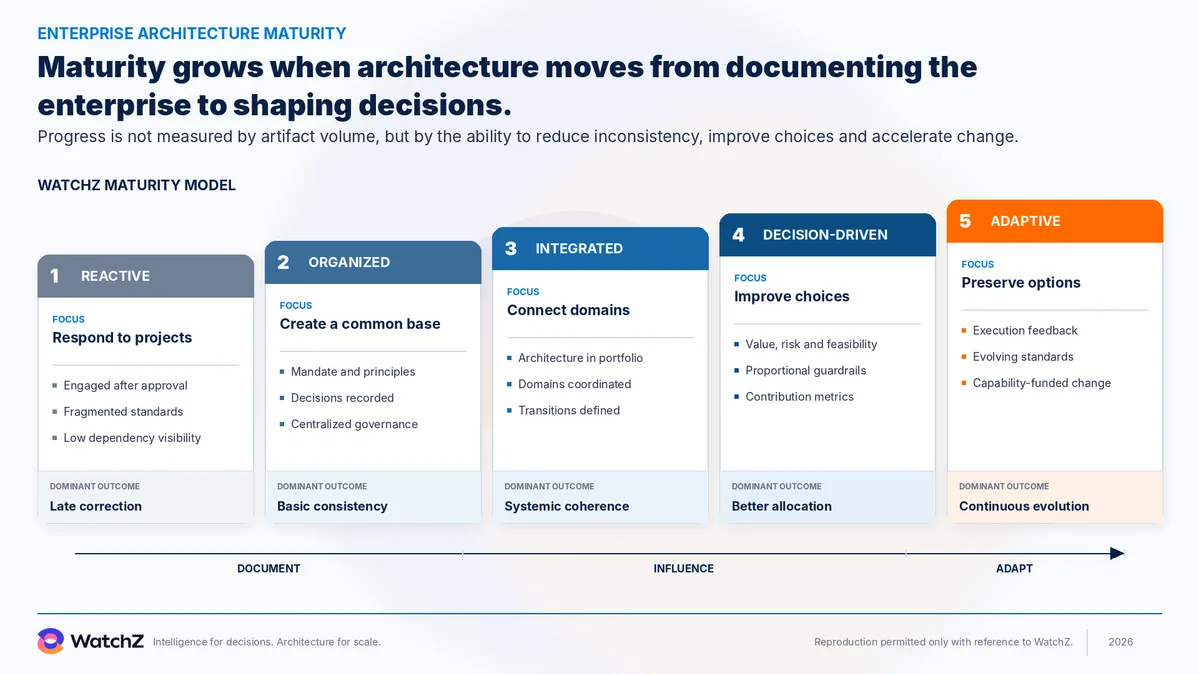
The maturity of the function appears when the organization answers clearly which capabilities need to evolve, which constraints block that evolution, which structural choices are available, which risks accompany each alternative and in what sequence the change can be executed. When those answers guide portfolio, funding and execution, architecture stops being a collection of artifacts and becomes an enterprise capability to decide better and preserve options for change. A capability assessment shows which level your architecture operates at today. At the moment of the next material technology decision, will your architecture qualify the choice or only review what has already been approved?
Sources
- WatchZ. "Enterprise architecture in practice guides investment, risk and execution". Revised editorial version, verified on July 13, 2026.
- U.S. Government Accountability Office. "Organizational Transformation: A Framework for Assessing and Improving Enterprise Architecture Management (Version 2.0)". GAO-10-846G, 2010.
- U.S. Government Accountability Office. "Information Technology Investment Management: A Framework for Assessing and Improving Process Maturity". GAO-04-394G, 2004.
- U.S. Government Accountability Office. "Enterprise Architecture Value Needs to Be Measured and Reported". GAO-12-791, 2012.
- Tamm, T.; Seddon, P. B.; Shanks, G.; Reynolds, P. "How Does Enterprise Architecture Add Value to Organisations?". Communications of the Association for Information Systems, v. 28, 2011.
- Plessius, H.; van Steenbergen, M.; Slot, R.; Versendaal, J. "The Enterprise Architecture Value Framework". ECIS 2018 Research-in-Progress Papers, paper 48.
- Ross, J. W.; Weill, P.; Robertson, D. C. "Enterprise Architecture as Strategy: Creating a Foundation for Business Execution". Harvard Business School Press / MIT CISR, 2006.
- van der Meulen, N. "Decision Rights Guardrails to Empower Teams and Drive Company Performance". MIT Sloan CISR Research Briefing, 2020.
- Souppaya, M.; Scarfone, K.; Dodson, D. "Secure Software Development Framework (SSDF) Version 1.1". NIST SP 800-218, 2022.
- Tabassi, E. "Artificial Intelligence Risk Management Framework (AI RMF 1.0)". NIST AI 100-1, 2023.