


A technology transformation can pay the consultant or pay the client. The difference rarely sits in the price of the proposal or the name of the methodology. It sits in the acceptance criterion the company contracted, in the discipline of prioritization and in the ability to sustain the change after the workshops.
Contracting to receive a diagnostic, a roadmap and an executive presentation is buying an archivable deliverable. Contracting to leave a capability working, with an owner, an indicator and economic impact, is buying something else. The same budget produces different results depending on what was defined as acceptance.
The defensible path has three movements. Executive capability diagnostic, economic prioritization and continuous operational sustainment. The order matters as much as the ambition, and the point where so many programs lose traction becomes clear further on.
The wrong decision is born before the first workshop
The biggest fragility in a technology transformation program appears before the roadmap is drawn. It appears in the contract. When the acceptance criterion asks only for a diagnostic, an executive presentation and an implementation plan, the company bought an archivable deliverable. It may be well structured and intellectually correct. Even so, it may not move results.
Technology transformation consulting should be contracted to reduce a business constraint through technological, operational and organizational capability. That changes the nature of the work. The focus stops being the production of artifacts and becomes the deployment of an observable capability, with a defined owner, a value metric, decision governance and continuity after the project.
The contracting question needs to be direct. Which capability will be working at the end of the cycle, under which owner, with which indicator and with which expected impact on revenue, cost, risk, productivity or customer experience. Without that answer, the company did not contract transformation. It contracted documentation with executive aesthetics. An executive capability diagnostic answers that question before the first dollar is spent.
Slides organize the conversation, they do not replace the change
The criticism is not aimed at the slide. Good materials align language, record decisions, organize trade-offs and speed up hard conversations. The problem starts when the slide becomes a substitute for the change. Maturity reports, heat maps and quarterly roadmaps have value when they guide choices and move to execution. When they stay isolated, they only sophisticate the inertia.
The most expensive pattern is familiar. The company runs the diagnostic, agrees with the conclusions, approves a roadmap and keeps operating the same way. The budget changes its name. The decision structure does not change. The data stays fragile. The architecture keeps reacting to demands. Security enters late. The teams keep disputing priority without economic criteria. The consultancy ends, and the constraint remains.
Real transformation leaves mechanisms. It leaves governance cadence, prioritization criteria, capability ownership, value metrics and a minimum review system. The value is not in declaring a new ambition. It is in reducing the distance between executive intent and repeatable execution.
The acceptance criterion measures capability working
A good acceptance criterion describes an operational result, not just a document. Instead of accepting only an evolution roadmap, leadership should require a minimum capability deployed, with rituals, owners, indicators, evidence and defined next improvement cycles.
That kind of acceptance changes the behavior of everyone involved. The consultancy starts designing something that survives the external team's departure. Internal leadership starts owning decisions that used to stay implicit. The technology area starts discussing value, risk and capability, not just effort and scope. The company starts seeing transformation as a management system, not an event.
Acceptance also filters vendors. Whoever lives on polished material avoids commitment to capability in operation. Whoever knows how to execute accepts being measured by adoption, governance, indicators and continuity, as long as the client also plays its executive part.
Three movements structure a defensible transformation
The first movement is the executive capability diagnostic. It reveals where technology stops converting strategy into result. The analysis looks at architecture, data, engineering, security, governance, operations, decision model, funding and the relationship between product and platform. A weak diagnostic points at symptoms. A good diagnostic shows constraints.
The second movement is economic prioritization. Not every gap deserves an initiative. Not every pain needs a large program. A company can capture more value by fixing portfolio governance than by swapping a tool. It can reduce risk by establishing architecture standards before migrating systems. It can accelerate delivery by building platform capabilities before scaling squads. Prioritization with economic criteria sets the sequence that ambition alone does not set.
The third movement is operational sustainment. This is where so many transformations lose traction. Without rituals, indicators, owners and executive review, the program reverts to project mode. Transformation has to operate as a continuous cycle of decision, execution, evidence and adjustment. Outside of that, the company only buys temporary clarity.
A gap without financial impact becomes a political dispute
Every organization has more problems than capacity to solve them. So prioritization without economic criteria turns into a dispute over influence. Whoever speaks loudest, holds more seniority or captures the narrative best jumps the queue. That model burns energy and erodes trust in technology.
The transformation agenda has to translate gaps into impact. Slow delivery can reduce revenue by delaying a launch. Fragile data can erode margin through poor decisions. Expensive legacy can drain cash through excessive maintenance. Low engineering quality increases rework. A lack of AI governance raises regulatory and reputational risk. When the impact appears, the conversation improves.
Not everything will be measurable with financial precision on day one. Even so, the company should declare hypotheses, proxies and validation indicators. The point is not to fake precision. It is to prevent relevant decisions from being made on narrative alone.
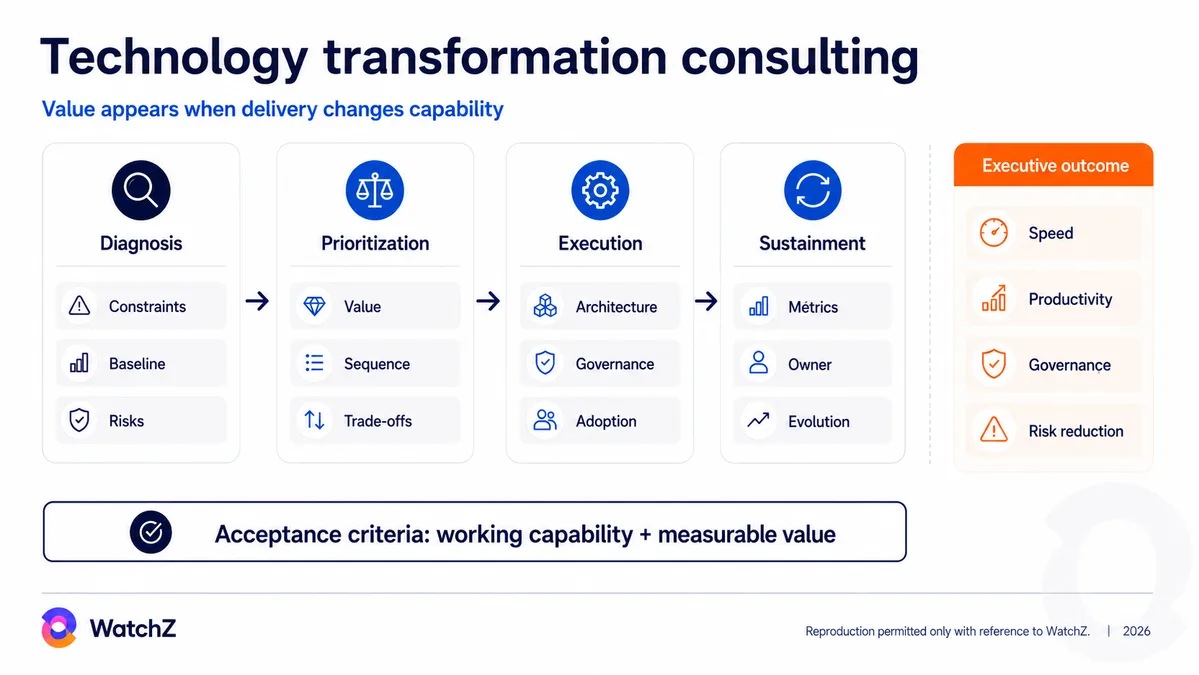
The asset below sums up this reasoning in an acceptance map. On the left, the four stages that need to work. On the right, the executive results that justify the investment.
The operating model decides whether the transformation scales
Tools do not sustain transformation on their own. A data platform does not fix decision quality without ownership, standards, governance and real use. A cloud migration does not reduce cost if architecture, FinOps and operations do not change. An AI program does not generate recurring value without reliable data, risk criteria, integration into the workflow and a result metric.
The operating model defines how technology work happens. Who decides, who funds, who executes, who measures, who answers for risk and who removes impediments. That design needs to be connected to the company's strategy. Without it, the organization builds local capability but loses enterprise coherence.
Modern technology transformation is less about swapping parts and more about orchestrating actors, assets and approaches. It integrates IT, business, security, data, product, architecture, partners and, increasingly, automation and AI. Maturity lies in the ability to coordinate that system without killing autonomy.
Useful consulting leaves mechanisms, decorative consulting leaves recommendations
Useful consulting asks questions that unsettle the decision structure. It asks which capability needs to exist, which constraint limits results, which trade-off leadership is avoiding, which metric will validate progress and which behavior needs to change for the transformation to survive the project.
Decorative consulting tends to protect the sale. It widens scope, keeps conclusions generic, avoids conflict, delivers polished presentations and leaves the deployment as the client's internal problem. The material may be sophisticated, and the risk stays where it always was. In the distance between decision and execution.
The difference shows up in the final artifacts. Useful consulting leaves management mechanisms. Decorative consulting leaves recommendations. Recommendations can be correct. Mechanisms make the organization change its execution pattern.
Five requirements shield the next proposal
Before contracting, leadership should require five elements. A clearly described target capability, a baseline of the problem, a value metric, an internal owner and a sustainment plan. Without those points, the scope stays vulnerable to pretty deliverables and low accountability.
It is also worth separating deliverable from evidence. A deliverable is the document, the workshop or the roadmap. Evidence is what shows the capability started to operate. Recorded decisions, tracked indicators, a backlog prioritized by value, an executive cadence in operation, defined owners, treated risks and planned next cycles.
A defensible acceptance checks six objective points.
- Target capability. The proposal states which capability will be working, not just which documents will be delivered.
- Baseline. The current constraint is described with minimum evidence, even if the metric is still a proxy.
- Value metric. Each relevant gap is connected to revenue, cost, risk, productivity, governance or experience.
- Internal owner. There is a defined owner to sustain the capability after the consultancy leaves.
- Decision cadence. Governance provides for rituals, trade-offs, indicator review and replanning.
- Evidence of operation. Acceptance includes operational signals such as a prioritized backlog, tracked metrics, recorded decisions and defined next cycles.
That distinction changes the governance of the engagement. Procurement buys less promise. The CIO reduces ambiguity. The CFO sees an economic rationale. The board receives a more defensible narrative of risk and value.
Conclusion
Technology transformation does not fail only because the company chose the wrong tool. It fails when it buys the wrong unit of value. The document matters. Capability working is what pays the bill.
The next consulting proposal deserves a simple lens. What will be operating when the consultants leave? If the answer is a presentation, the company bought temporary clarity. If the answer is a capability with an owner, an indicator, a cadence and economic impact, the company bought a transformation with a real chance of paying the client. Revise the acceptance criterion before revising the methodology. Acceptance defines the game.
Sources
- WatchZ. "Consultoria de transformação tecnológica." Published May 23, 2026.
- McKinsey. "How to get your operating model transformation back on track." 2025.
- McKinsey. "Unlocking success in tech-enabled transformations." 2018.
- Gartner. "From IT Control to Technology Operating Model Orchestration." 2026.
- Gartner. "Use the Value-Optimizing IT Operating Model to Advance Transformation." 2024.
- BCG. "Transformation Strategy Consulting." Institutional page consulted in 2026.