


Companies do not hire an assessment because they lack reports. They hire because they need to decide better and cannot. The error starts when the diagnostic begins from the wrong question. "Where are we behind?" produces a benchmark, an inventory and a comparison. It can generate a well-diagrammed deliverable. It rarely changes capital allocation.
A technology capability assessment has to begin somewhere else. The right question is which decision the company needs to make when the diagnostic ends. That sentence redesigns the entire engagement. It defines what to measure, which evidence to gather, who needs to take part and what kind of recommendation will hold value for the executive committee.
The path has four requirements. Begin from the decision question, evaluate the layers as a system, connect every gap to an economic consequence and leave with a thesis for action. The order protects the investment. The reason so many diagnostics end without an owner comes at the end.
The wrong request turns an assessment into an inventory
"Evaluate our technology maturity" sounds like a good request. It is too broad to guide a decision. The answer can be a score, a heatmap, a list of gaps and a comparison yardstick. All of that informs. Little of it directs.
Compare it with harder questions. Can we sustain expansion into new markets without doubling technology cost? Can we reduce time to launch without raising operational risk? Do we have the installed capability to capture value with AI without depending on fragile data, unstable integrations and improvised governance?
Those questions force the assessment to take a position. They make clear what needs to be measured and which executive consequence is at stake. The goal stops being to know where we are. It becomes understanding what keeps the strategy from advancing with safety, speed and return.
The executive question defines depth, evidence and reference
A mature assessment does not evaluate everything with the same intensity. It concentrates depth where the decision demands evidence. If the question is geographic expansion, architecture, integration, operation, support and change governance gain weight. If the question is AI, then data, security, traceability, oversight and capturable value move to the center.
External benchmarks help, but they should not command the diagnostic. The decisive reference is the distance between the business ambition and the capability installed today. A company can sit below average in one practice and still not have its greatest risk there. It can sit above average in another and remain unable to execute the strategy at the pace required.
That is the consulting turn. Maturity is an input. The decision is the product.
Four layers have to be evaluated as a system
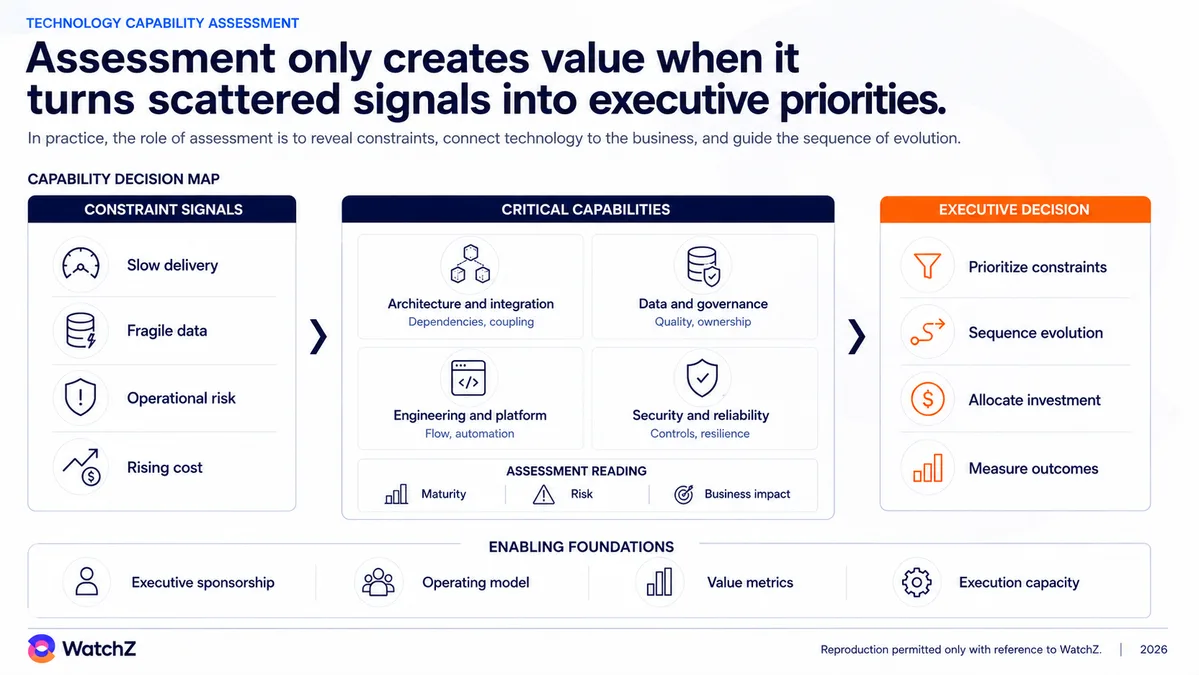
Technology capability does not live in a single discipline. It emerges from the combination of governance, architecture, engineering, operation, data, security and responsible use of technology. Evaluating each front in isolation creates a checklist. Evaluating the interdependencies creates a diagnostic.
Strategy and governance
The question is not whether a committee exists. It is who decides, with what criteria, at what cadence and with what accountability. Governance that is too heavy delays decisions. Governance that is too light returns the cost through rework, risk and misalignment. The right point is not ideological. It depends on risk appetite, operational complexity and the speed needed to compete.
Architecture and systems
Systems architecture determines the cost of change. When integrations are fragile, domains are confused and critical systems have no clear boundaries, every strategic initiative pays an invisible tax. The assessment has to make that tax explicit. Where the architecture accelerates, where it blocks and where it transfers complexity to the operation.
Engineering and operating model
Not all low throughput is a lack of talent. Often, good teams operate inside a design that multiplies handoffs, approvals, dependencies and rework. The diagnostic has to separate team limitation, organizational design, technical debt, low autonomy and missing ownership. Without that separation, the company treats the symptom as the cause.
Data, security and AI
Usable data, access control, traceability, security and operational oversight are no longer peripheral topics. They define whether automation and value that can be captured with AI leave the pitch and enter the operation without widening risk. The assessment has to evaluate whether the company can operate advanced technology with governance proportional to the impact of the decision.
A score with no economic implication is decoration
The aggregate score tends to be the least useful part of an assessment. It simplifies the conversation and rarely guides the next decision. A maturity score does not tell the CFO how much capital to preserve, the CIO which dependency to remove first, the COO which bottleneck to unlock or the CEO which strategic promise is at risk.
What changes a decision is the map of implications. Every gap has to be connected to a consequence. Deferred revenue, recurring cost, operational risk, regulatory exposure, lost speed, quality decline, vendor dependency, low scaling capacity or a worse customer experience.
A gap without an implication becomes backlog. A gap with an economic consequence becomes an executive agenda, and the sequence of corrections becomes a result-driven evolution roadmap.
Readiness protects cash, margin and executive trust
The most expensive investment is not always the one that stays idle. Often it is the one that advances without readiness. The company buys an advanced platform before solving integration, data quality and ownership. It accelerates engineering hiring on top of an architecture that consumes the added capacity in coordination. It launches AI initiatives before defining guardrails, metrics and oversight.
The cost shows up later. Deadlines that slip, an operation that absorbs exceptions, a budget that fragments, risk that grows and executive trust that declines. When that happens, technology stops being a lever and becomes a permanent suspect in the capital discussion.
Readiness is not waiting for the organization to become perfect. It is knowing where to accelerate, where to simplify, where to protect and where to correct before the strategic program absorbs the cost of the constraint. A structured capability diagnosis exists to reveal that sequence before the first dollar is spent.
A mature assessment delivers a thesis for action
A useful assessment leaves the executive room with a thesis for action. That thesis answers five questions. Which capabilities limit the strategy now. Which gaps have the greatest impact on cost, risk, speed, margin or experience. What needs to be corrected before new investments. What can be handled in parallel without stalling the agenda. How the evolution will be governed, measured and reviewed.
That is the point of maturity. The document of findings becomes a mechanism for allocating attention, capital and accountability.
Read the topic without chasing trends
Technology capability goes beyond a modern tool. Cloud, AI, platform, observability and automation matter when they reduce friction, increase security, improve throughput, raise reliability or create a base for growth. Outside that, they become cost with a nice name.
The risk sits in treating each trend as the answer before framing the question. One company may need to modernize architecture before scaling AI. Another may need to improve governance before increasing investment. Another may discover that the bottleneck is not in technology, but in priority, funding, decision-making or the operating model.
A good assessment does not sell a single solution. It protects the organization against the premature solution.
Conclusion
A technology capability assessment should not answer only what the company has. It should answer what the company can do with what it has, what is missing to execute the strategy and which sequence reduces waste, risk and opportunity cost.
Before hiring the next diagnostic, write the question it needs to answer. Without that question, the likely result is a sophisticated portrait of the current situation. It can be attractive. It can be thorough. It will rarely be decisive.
The assessment worth the investment does not describe maturity. It changes the decision.
Sources
- WatchZ. Original article: Technology capability assessment in practice.
- McKinsey. Tame tech debt to modernize your business.
- McKinsey. The greatest gift to the business: A strong technology architecture.
- Team Topologies. Key concepts and practices for applying a Team Topologies approach.
- NIST. AI Risk Management Framework Core.
- DORA, Google Cloud. Accelerate State of DevOps Report 2024.