


"Platform Engineering or DevOps?" opens most discussions about engineering modernization. And it is the wrong question. The two do not occupy the same place in the operating model, so treating them as alternatives leads a company to invest in the wrong layer for its stage.
The real decision is to identify which constraint keeps engineering from converting investment into flow, reliability and result, rather than to pick a trend. When the constraint is in how teams deliver, the return tends to come from DevOps. When the constraint is the repetition of the same work by several teams at scale, Platform Engineering becomes a plausible answer.
DevOps did not lose ground. Scale is what made an explicit platform capability economically justifiable in some organizations. This piece separates the two, shows when each one pays back the investment and how to measure value without confusing adoption with result.
The wrong comparison produces the wrong decision
The question "Platform Engineering or DevOps?" starts from a faulty premise. DevOps is a sociotechnical movement that distributes collaboration, automation, feedback and responsibility across the software life cycle. Platform Engineering is the practice of building and operating shared capabilities as internal products, so that product teams consume safe, reusable paths without rebuilding the base at every delivery.
The difference changes investment, accountability and organizational design. A company can practice DevOps without keeping a formal internal platform. It can also create a "platform team" and stay far from DevOps principles, when it centralizes decisions, piles up tickets and hands dependency back to the teams. The name of the area does not prove the capability.
The correct executive decision starts from another question. Which constraint dominates the delivery system today? When the problem is in handoffs, low automation, fragile tests, split ownership or slow feedback, the return tends to come from strengthening DevOps capabilities. When the problem is the repetition of the same work by several teams, the variability of controls, cognitive load and the difficulty of scaling governance without creating queues, Platform Engineering becomes the more likely answer.
DevOps is a distributed capability, not a department
DevOps is often reduced to pipeline, infrastructure as code or a role between development and operations. That reading is insufficient. The central point is to create conditions for software changes to advance with safety, speed and shared responsibility. This involves architecture, working in small batches, continuous integration, automated tests, observability, change management and learning from incidents.
When the organization creates a "DevOps team" that receives deploy, configuration and infrastructure requests from every product, it rebuilds the handoff it meant to eliminate. Automation grows, but the model stays tied to a central queue. The problem is the separation between who produces the change and who answers for the conditions of execution, not the team's title.
That is why DevOps remains a cross-cutting discipline, not a maturity stage to be abandoned later. The platform, when needed, amplifies these practices and reduces the effort to adopt them, instead of replacing them.
Platform Engineering turns repetition into an internal product
The platform appears when scale changes the nature of the waste. In a small environment, letting each team configure pipelines, observability and infrastructure can be acceptable. As products, regulatory requirements, environments and teams multiply, the same autonomy starts to produce duplication, inconsistency and operational exposure.
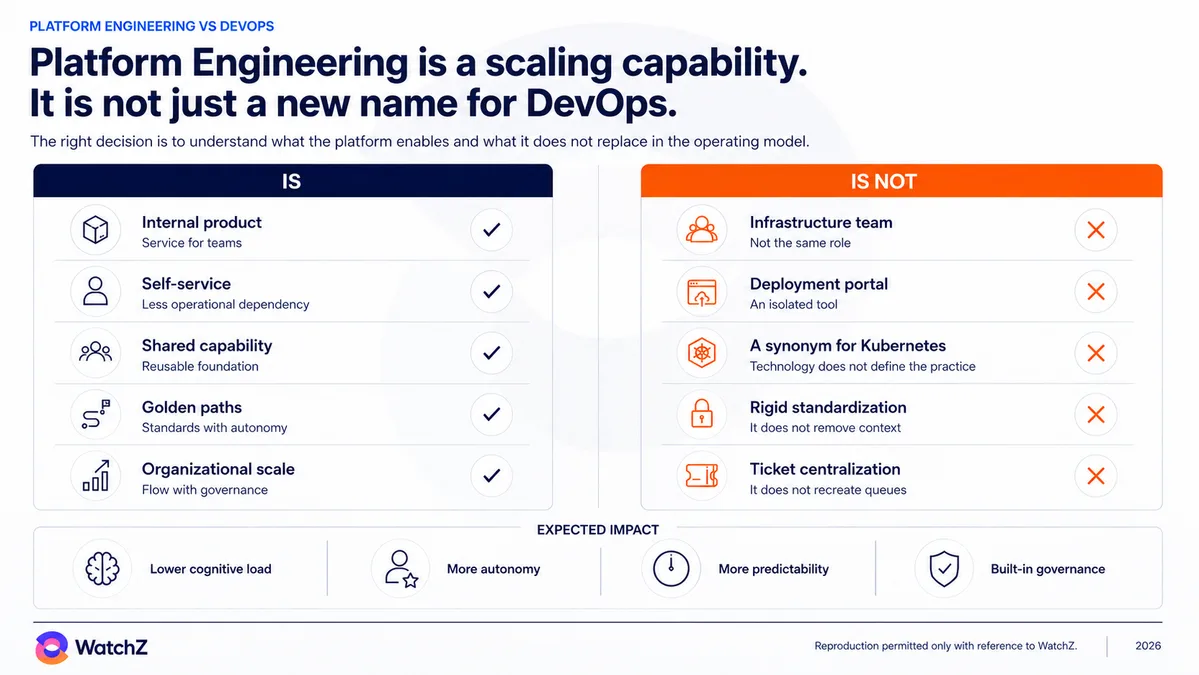
Platform Engineering organizes common capabilities into an internal value proposition. This can include service templates, on-demand provisioning, standardized pipelines, ready telemetry, identity management, policy as code, service catalogs and recommended paths. The goal is to reduce choices that do not differentiate the product, preserving enough context for teams to operate with responsible autonomy.
The platform has to be treated as a product. This requires research with internal users, vision, roadmap, adoption and satisfaction indicators, service reliability and an explicit process to decide what enters scope. Without that discipline, the platform becomes a collection of tools or just another support layer.
The economic case must come before the structure
Building a platform involves opportunity cost, specialized talent, continuous operation and the risk of creating premature abstractions. The economic thesis only holds when the value of reuse, standardization and reduced cognitive load outweighs that investment.
The business case should estimate where repeated work exists and how much it consumes. Onboarding time, effort to create environments, pipeline maintenance, incidents from divergent configuration, manual controls and dependence on specialists are useful signals. The analysis does not need to promise impossible financial precision, but it should reveal the order of magnitude of the waste and the value hypothesis that will be tested.
A platform does not deserve investment because the market talks about Platform Engineering. It deserves investment when there is repeated demand, identifiable users, product capability and a set of journeys whose redesign can improve flow, reliability or risk in a measurable way.
Five signals show that strong DevOps is no longer enough
The first signal is persistent duplication. Different teams build and maintain variations of the same delivery capabilities. The second is inconsistency that affects risk, when security, observability and recovery standards depend on local knowledge. The third is slow onboarding, because starting a product requires navigating dozens of decisions and dependencies. The fourth is the concentration of knowledge in specialists who become an organizational bottleneck. The fifth is the difficulty of applying governance without manual approvals that block the flow.
No single signal proves the need for a platform. The decision depends on the frequency, impact and reach of the problem. An organization with few teams and low repetition can solve bottlenecks with architectural simplification, better documentation or targeted automation. A company with dozens of products may require an explicit internal-product layer to keep each new team from raising the marginal cost of engineering.
Centralizing everything in the name of standardization is the most expensive mistake
Platforms fail when they confuse enablement with control. By trying to decide every tool, architecture and flow, the platform team becomes the owner of an impossible backlog. Product teams stop operating with autonomy and start negotiating exceptions or waiting for service.
The healthier design separates what needs to be uniform from what should stay local. Basic security, identity, telemetry, traceability and regulatory requirements can justify mandatory guardrails. Language, framework or domain architecture usually require more freedom. Golden paths should be attractive because they reduce effort and risk. When every adoption depends on imposition, the platform probably has not delivered enough value.
The platform also cannot absorb the operational responsibility of the products. Teams remain responsible for the services they build. The platform provides capabilities, contracts and clear limits. That boundary preserves ownership and keeps the new function from recreating the old divide between development and operations.
Adoption metrics measure usage, not result
Number of users, provisioned services and portal accesses measure usage, not result. A robust evaluation combines four perspectives. The first is delivery performance, with lead time, deployment frequency, recovery time, change failure rate and rework. The second is developer experience, with satisfaction, task success and time lost in friction. The third is the reliability of the platform itself, with availability, latency, support and contract fulfillment. The fourth is economic effect, with operational effort per team, reduced duplication and capacity freed for product work.
The delivery metrics consolidated by the DORA program, such as lead time and deployment frequency, anchor the first perspective. They require careful causal reading. An improvement in lead time can come from architectural change, prioritization or reduced scope, not only from the platform. The goal is to gather evidence that lets you test the value hypothesis, without attributing every positive result to the most visible initiative.
A four-step decision model
First, diagnose the dominant constraint. Map the journey from idea to production and identify where time, rework and risk accumulate. Second, measure repetition and variability. Find which capabilities are rebuilt by several teams and which differences generate cost without creating advantage. Third, select a high-value, low-coupling journey for a minimum platform product that solves a proven pain. Fourth, treat adoption as evidence of value, with feedback, telemetry and operational results guiding the roadmap.
This process avoids two extremes. Building a broad platform before understanding the users, or keeping unrestricted autonomy when the cost of duplication already compromises scale. Prioritization by economic criteria helps order where to invest first.
DevOps and Platform Engineering form a single operating system
DevOps defines how the organization learns, delivers and operates in a distributed way. Platform Engineering decides which common capabilities deserve to become internal products to reduce friction and variability. One approach without the other produces imbalance. DevOps without a platform can push excessive complexity onto each team. A platform without DevOps can centralize decisions and destroy ownership.
Maturity is in recognizing the right constraint, designing clear boundaries and measuring whether technology started to deliver changes with more safety, speed and efficiency, not in adopting one more name. The company does not need to choose between DevOps and Platform Engineering. It needs to decide where to standardize, where to preserve autonomy and which investment improves the economics of its delivery system.
Conclusion
The decision between strengthening DevOps and investing in Platform Engineering is a reading of constraint, not a choice of trend. Fragile flow calls for stronger DevOps. Repetition and variability at scale justify investigating a platform treated as an internal product.
The expensive mistake is renaming the problem. Creating a platform team without resolving culture, architecture and ownership only moves the bottleneck elsewhere. A capability assessment separates the real constraint from the fad before the investment. Which constraint dominates your delivery system today, and does it call for stronger flow or shared capability as a product?
Sources
- WatchZ. "Platform Engineering vs DevOps: what is the difference?". Revised on July 10, 2026.
- DORA. "Capabilities: Platform engineering". https://dora.dev/capabilities/platform-engineering/
- DORA. "Software delivery performance metrics". https://dora.dev/guides/dora-metrics/
- DORA. "Accelerate State of DevOps Report 2024". https://dora.dev/research/2024/dora-report/
- Google Cloud. "What is DevOps?". https://cloud.google.com/devops
- AWS. "What is DevOps?". https://aws.amazon.com/devops/what-is-devops/
- CNCF. "What is platform engineering?". https://www.cncf.io/blog/2025/11/19/what-is-platform-engineering/
- Fowler, Martin. "Mind the platform execution gap". https://martinfowler.com/articles/platform-prerequisites.html
- Fowler, Martin. "How platform teams get stuff done". https://martinfowler.com/articles/platform-teams-stuff-done.html
- Team Topologies. "Key Concepts". https://teamtopologies.com/key-concepts
- Thoughtworks. "Platform engineering product teams". https://www.thoughtworks.com/en-gb/radar/techniques/platform-engineering-product-teams